WELCOME

WELCOME! For the last 19 years, about once a month, usually on a Thursday evening, a group of writers, illustrators, teachers and librarians meets in the Los Feliz area of Los Angeles to discuss children's books. Lately we have started meeting at lunch time, once every three months. Usually we talk about one picture book and one middle grade or YA novel. After the meeting, Sandy Schuckett, a retired LAUSD librarian, summarizes our discussion. Here are her reports of our thoughts about the books we have read. We'd love to have your comments too!
Thanks to Nancy Hayashi for our wonderful title art! NOTE: We are changing to a new schedule. Our meetings will now be quarterly and during the afternoon. Our group has been meeting since 2007. It was organized under the auspices of the Children's Literature Council of Southern California (CLCSC).

Showing posts with label nonfiction. Show all posts

Thursday, June 11, 2026

THE SPIDER LADY by Penny Parker Klosterman and WHITE LIES: HOW THE SOUTH LOST THE CIVIL WAR, THEN REWROTE THE HISTORY by Ann Bausum


For an all-nonfiction meeting we started our discussion with our picture book, The Spider Lady by Penny Parker Klosterman -- a true account of Nan Songer, a young girl whose lifetime obsession with spiders and the extraction of silk from their webs led to her becoming a World War II heroine who supplied the silk from black widow spiders' webs to be used as crosshairs in guns, bombers, periscopes and other U.S. military tools. Although we all agreed that this was a great story about Nan's perseverance and learning from experimentation via her own "scientific method," sadly the physical presentation of this picture book for older readers left a lot to be desired. Here are the things we found problematical: the very light-colored text was difficult to read; the almost monotone palette of the illustrations -- which was pleasant at first -- became tedious as it continued on and most of the pictures just showed Nan working with spiders; the little blocks (sidebars) of additional information were distracting as well as being difficult to read due to lack of contrast between their text and background; the book was too long with writing that didn't really have a 'voice'; the Back Matter which did present an Author's Note and Bibliography could have presented more detailed information as well as scientific pictures of the different types of spiders shown randomly throughout the book. SO...though spider-loving middle-schoolers or science teachers would probably be intrigued with this book as a springboard to further research on spiders and/or Nan Songer, as a general read-aloud it would not really work well, due to the myriad problems delineated above.


We had a great discussion about our (much) longer YA nonfiction book, White Lies: How the South Lost the Civil War, Then Rewrote the History by Ann Bausum. We all agreed that although a very long read, this book presented many new facts about the Civil War and its causes and aftermath, and it was great that it was published during this time when some U.S. History is a victim of efforts to 'cover up' the so-called unpleasant parts. We liked that it focused on the stories of individual participants in the various scenarios that the author described. We appreciated the Introduction where the author explained why she wrote this book, but some readers were put off by the tone of anger shown by the writer, a white woman who grew up in the south, learning the 'Lost Cause' myths about the Civil War, etc. that were prevalent throughout her schooling who didn't realize the truth until much later -- after a great deal of extensive research -- which we also appreciated. We would have liked it even better if she had included more sources of personal recollections of people who were involved. Once again we were unhappy with many facets of the format: the very small text; the black print on grey paper and very small white print on black paper inserted in the middle of each chapter was hard to read, not to mention very distracting, and the extra inclusions of details of specific Civil War monuments throughout equally so. The Source Notes and extensive Bibliography in the back matter were excellent, but once again -- difficult to read due to even smaller type size; the inserted groups of pictures throughout had no specific connections with the actual text that we were reading at that point. Some readers also wondered whether YA readers of today would even pick up this book to read, but we felt it was a good resource that could be introduced by teachers and that it might be a stimulus for further student research. We thought it was "...an important book that maybe won't change anything," but we were glad that it had been written. 

 A note on format: It appears that more and more nonfiction books for young readers are being published to supposedly cater to their 'decreased attention spans.’ Many books now seem to try to emulate websites, with a lot of 'stuff' stuck in, in different fonts or print sizes, sidebars, etc. Whether this is a good thing or not remains to be seen, but as adult sophisticated readers, we have usually found it very distracting. 

Monday, December 15, 2025

PAPER SON by Julie Leung and PIE IN THE SKY by Remy Lai


We had a great meeting with lotsa great 'pot luck' dishes, a terrific discussion, and just fun being together. We began with our picture book, 
Paper Son by Julie Leung; illustrated by Chris Sasaki. We all felt that this story of Tyrus Wong, a Chinese-American who immigrated to the U.S. as a 'paper son', and went on to become a noted painter in multiple media who created all of the scenery for the 1942 world-famed Bambi film and as an older man a noted maker of Chinese-style 'flying' kites . We all agreed that this was an important story to know, and some were surprised to know of Wong's history with the Walt Disney film. But we had mixed feelings as to the book itself. A couple of readers liked the beginning pages that depicted young Tai Yow's entry at Angel Island and early days as a Chinese immigrant who had to lie about his identity in order to be admitted to the U.S., and whose name was Americanized to "Tyrus" by his teachers in his Sacramento school. We liked how it depicted his early talents in art, and how he used many Chinese art techniques in his work, even as a young boy. But many of us felt that as the story of the events of his life continued it became more 'adulty' with less emotion, and that a better-written story would have been more interesting to young readers. We all liked the illustrations, and were surprised to learn that they had been done digitally by Sasaki. But we did note the emotional feelings they evoked, as well as the very subtle portrayals of the prejudice Wong experienced from the moment he arrived and as he continued to function in the American environment of his time. We wished there had been more about Los Angeles during that time, which is where Wong had settled, as well as more about his family, who were only shown in one photo in the Back Matter of the book. We wanted to know more, and were sorry that the Author's Note basically repeated the story in the book, and provided no more details for readers. We felt that this book would have many uses at different grade levels -- as an introduction to the life of an important Chinese-American artist, and for art teachers or for class discussions related to immigration and the feelings of new immigrants in our country.


We also had mixed feelings about our novel, Pie in the Sky by Remy Lai. Although it had been billed as a 'humorous' book, many of us did not feel there was much humor...except maybe in Lai's 2-color cartoon-like depictions of many scenes in the story between 12-year-old Jingwen and his 9-year-old brother Yanghao, who had been taken by their mother from an unnamed country to Australia after their father, a bakeshop owner, had died in an auto accident. We wished we knew where they came from and why they chose to move to Australia. We liked the fact that the story dealt with the issues of relocation, not knowing English, not really having friends, sibling rivalry, lying to his mom, etc., but -- we felt that this had been done so many times before, and this book added nothing new, and could have been shorter. The crux of the story (and what made it so long) was that the brothers tried to bake the 12 different cakes that Jingwen felt  could honor his father, but we never really knew why. (...and we wished there had been recipes!) Some of those situations were implausible, and details here would make this recap too long also. We felt that by the time we got to the end of the book (which a few readers couldn't even finish) we were tired of the baking scenarios, and the 'climax' of WHY Jingwen wanted to do that was finally revealed. We did, however, agree that young readers would probably like this book, many of whose pages resembled a graphic novel, and that the humor in the illustrations might keep them reading. It wasn't a bad book; just not a thrilling one.

Tuesday, September 30, 2025

TREE. TABLE. BOOK. by Lois Lowry and CLEVER CROW by Chris Butterworth


We had a great meeting on Sept.18. We discussed our novel, Tree. Table. Book. by Lois Lowry first. We all agreed that Lois Lowry, who has published more than 40 books for young readers, still 'has it' and knows how to create a good story and keep readers engaged. However, a few readers were bored by the beginning and felt that this book started too slowly, and they were not really interested in knowing so many of the details of middle-schooler Sophia's life in small town-New Hampshire. Others of us thought Sophia's voice was perfect, and knowing all these details about her enhanced our understanding of her relationship with her 88-year-old neighbor Sophie who liked many of the same things she did, and shared an offbeat sense of humor...even as she was entering the early stages of dementia. But we all agreed that Sophie's stories, as she was being put through various memory tests by her information-gathering young friend, were the most engaging part of the book, and that she was actually the star of the story. We also appreciated the depth of Sophie's memories as she told of her early life during what was obviously the beginning of the Holocaust -- prompted by three words: Tree. Table. Book. We also liked the depiction of the relationship between young Sophia and her best friend Ralphie, and the way they dealt with another little boy, Oliver, who was brilliant, quite eccentric, and appeared to be on the Autism syndrome -- although it was never necessary to mention that by name. We loved that the kids were very sensitive to him and to his needs, and were protective without trying to change him. The only thing we all felt could have been left out was a whole section about an abandoned house that Sophia imagined they could smuggle Sophie into when her son wanted to move her to an assisted living facility. We talked about several more of the details from this story, but to add them here would make this Recap almost as long as the book. We agreed that the ending was plausible, and probably the best outcome for all. Some readers wondered about the target age group for this book, since they felt that kids that age wouldn't know anything about the Holocaust or Autism. But others of us thought that didn't really matter, since it was the understanding,  humanity, sensitivity, and love between these two almost identically-named females -- one young, one old -- that were the strength of this engaging story.


Our discussion of our picture book, Clever Crow by Chris Butterworth was significantly shorter! We all liked the mostly-shades-of-grey-and-black illustrations by Olivia Lomenech Gill, which -- though very accurate --were not actually photographic. But many of us felt that they would have been even better with more color. Our main problem was with the text, which didn't flow in any meaningful way, and merely contained random facts presented in a dully-written manner. We couldn't really figure out why various parts of the text were presented in differently sized fonts -- from 'normal' for the 10"x10" large page size to larger to huge. However, we did feel that this book could be useful in a school setting for any primary class studies of different types of birds. We especially liked the end papers: the front ones showed pictures and relative sizes of various crows' family eggs; the rear ones showed very accurate depictions of the various birds in the crow family. Many of us had not been aware of most of them! And the short 'lesson' for using an Index shown at the very end of the book could also be very helpful in a classroom.

Monday, November 13, 2023

SMART COOKIE by Elly Swartz and THE GARDENER OF ALCATRAZ by Emma Bland Smith


We began our November discussion with our novel, Smart Cookie by Elly Swartz. We had several issues with this book. Although we thought that the major plot point, Frankie's efforts to find a mate for her dad online after her mom's death in a thunderstorm, was a good idea, but it lacked depth. We felt that there was just too much other stuff happening -- ghosts, friendship problems, hoarding, rules, secrets, and more that got in the way of the plot and were never properly developed or resolved. We liked the relationship between Frankie and her best friend Elliot and between Frankie and her dad and grandma, but since there was so much other 'mini-plot stuff' to think about none of us really felt anything as the story proceeded. We did agree that young readers of the target age group (8-12) would probably like the book, and anything that keeps a kid reading is good.


We liked both the great opening and the tone of the writing of our picture book, 
The Gardener of Alcatraz by Emma Bland Smith, which told an easily accessible story of Elliott Michener, a convicted counterfeiter, who had been transported from Folsom Prison to Alcatraz, decided to be a 'good guy', and ultimately redeemed himself by tending the Alcatraz garden outside of the prison walls. We thought the engaging story showing that people can change would be good for young readers as they read about Elliott's passion and pride as he learned more about gardening and gained skill. We thought Jenn Ely's illustrations were well done in terms of showing facial expressions, changes in perspective, and the way that color crept into the garden that developed in a previously barren place. We agreed that the back matter, for those who would read it, was helpful in presenting further details about Elliot's life and encarceration, the Alcatraz garden, background on (usually un- or poorly-paid) prison labor, treatment of nonwhite prisoners, and other social issues. We thought the book might be especially relatable for students who had incarcerated parents or relatives, and could present some hope of redemption and transformation through the idea that one is not 'just a prisoner.'

Thursday, September 21, 2023

ATTACK OF THE BLACK RECTANGLES by A.S. King and NANO: THE SPECTACULAR SCIENCE OF THE VERY (VERY) SMALL by Jess Wade


We started with the discussion of our novel, Attack of the Black Rectangles by A.S. King. There were things about this book that we all liked: the fact that it dealt with reading, honesty, and current issues of censorship that are part of the general conversation (sadly/still!) in today's society. But most of us felt that much of the characters' 'dialog' regarding not only the fact that words had been redacted (by their teacher, Ms. Sett!) from The Devil's Arithmetic by Jane Yolen, but also long discourses re: women's rights, treatment of Native peoples by Columbus, Anglicizing a Vietnamese student's name, and other present-day issues turned 6th-grader Mac and his friends into didactic mouthpieces for the points the author wanted to make in this story. We liked the fact that Mac had been exposed to many well-known and excellent examples of children's literature, and we hoped that young readers, upon seeing those titles in this book might want to read the books mentioned. We liked the idea that Mac was encouraged to speak his mind by his mom and his grandpa, and we saw his growth as he and his friends excited the whole community of his small town and brought them on board to protest this act of censorship in front of the school board. We were somewhat puzzled by the additional storyline of Mac's dad: an impulsive, angry, and somewhat dishonest man who was obviously in the throes of some mental illness issues. Mac just wanted to know the truth about his dad, which was being kept from him and prevented him from feeling whole. But -- though the issue of honesty was emphasized throughout this book -- a couple of us felt that the story itself was somewhat dishonest in the way it ended, where the kids won, Ms. Sett promised to not redact any more books, and everyone lived happily ever after. In today's real world it unfortunately wouldn't happen that easily. We did like the emphasis on keeping an open mind and reacting with grace in uncomfortable situations which Mac consciously always tried to do. We felt that young readers would probably like this story of family, friendship, first crush, and frankness.


We had mixed feelings on our picture book, Nano: the Spectacular Science of the Very (Very) Small by Jess Wade. We thought this simplified explanation of the very complicated science of nanotechnology was basically well-done. We liked how it started in an almost poetic way with the very fundamental knowledge that youngsters have about what makes up our world. Some of us felt that when it got into more scientifically detailed explanation the text became less fun to read and seemed more like a very dryly written textbook. Most (but not all) of us thought the strangely colored illustrations were terrific, and we all liked the fact that a little girl was shown on each page exploring whatever the text was attempting to explain. We thought this was especially encouraging for young female readers who were interested in science. We liked the pages at the end that contained even more detailed explanations of nanomaterials and a brief index. We felt that most young readers would probably not pick up this book on their own, but that an adult might alert them to it and that they might enjoy it. We also felt that it was a basic introduction to nanoscience that would be valuable for middle-schoolers and even those in high school.


Thursday, August 17, 2023

THE BEATRYCE PROPHECY by Kate DiCamillo and THE SECRET CODE INSIDE YOU: All About Your DNA by Rajani LaRocca


At our August meeting we began with our novel, The Beatryce Prophecy by Kate DiCamillo and illustrated by Sophie Blackall. Most of us had varying degrees of love for this book for a variety of reasons. We all appreciated the seemingly very simple, but actually very deeply thought out text, which at times felt like a fairy tale and at other times felt even biblical. We appreciated DiCamillo's amazing storytelling skill, and w
e also felt that the black/grey illustrations done with "real and digital pencils" were entirely appropriate. We were enamored by Beatryce, who, during the medieval times in which she lived, was destined, according to an ancient prophecy, to become king. Beginning when she is found in a pen with a goat, Answelica, and with amnesia, the story goes on to explore her quest to find out who she really is, and to find out what her place is in the world. There are so many details that become evident as the story proceeds -- too many to mention here -- but the main one is that she knows how to read and write, which is prohibited for girls in the time she is living. With the help of a monk, Brother Edik; a boy, Jack Dory; an ex-king, Cannoc; and the goat, Beatryce's perseverance leads her through many hairy adventures en route to the palace. We loved the way that the story developed as we learned the reasons that each character joined her quest; we loved the suspense, and the final resolution, which made a reader feel the power of love as well as the power of story and the importance of reading. One reader was less enamored of the book, and although she did like the story and the writing, she felt it might be a bit too didactic as far as Beatryce's strength as a female and the importance of reading were concerned. We all felt that young readers would become fully engaged in this book from the very beginning, and that since it is a relatively easy read (and not too long) they would stick with it until the end -- where they could not help but to feel -- something!


We decided to read The Secret Code Inside of You: All About Your DNA by Rajani LaRocca and illustrated by Steven Salerno because we had loved her writing in Red, White, and Whole, which we discussed in July. We wanted to see what she would do with a nonfiction picture book for younger readers. We had varying opinions on this book whose role was to simplify the very complicated subject of cells, DNA, chromosomes, genes, and how they all create specific  characteristics in humans and animals. Some of us liked the rhyming couplets that comprised the text throughout the book, others thought they were terrible, and that the introductory part of the book -- before getting into the actual science -- was too long. We all basically liked the illustrations, which were quite colorful, and did show what the text talked about -- like the cell and the double helix of the DNA. One reader felt that this book was terrible -- that it wasn't totally scientifically correct, and that it was poorly written. But most of us felt that kids could definitely learn from it but probably would be unlikely to just pull it from a library shelf.  However, if a teacher or parent read it to them and showed them the pictures they might want to read it again themselves, and might even want to read more books about this topic. We did feel that the back matter of the book was helpful, but probably for adults -- since young kids rarely read it. 

Thursday, April 27, 2023

COUGAR CROSSING by Meeg Pincus and GREENGLASS HOUSE by Kate Milford


Once again we were unanimous in our reactions to both of our books. Usually we begin with our picture book, but this time we decided to start with the novel, Greenglass House by Kate Milford, because we wanted to get it out of the way because -- well -- here are some of the comments: didn't finish it; too much effort/no payoff; didn't hold the reader's attention; too slow; chapters were too long; too convoluted; too complicated; couldn't figure out when/where the story happened; disengaged parents; main character, Milo, not compelling; secondary character, Meddy, not nice/too bossy; plot had too many names/stories to remember; and I could go on, but I won't. A couple of readers did finish it, and -- on the positive side, liked the natural setting, the vocabulary used in the description of the windows of the house -- varying shades of blue and green, and the fact that Milo, who was adopted, was Chinese, unlike his adoptive parents (although it took ages to get into his actual adoption story.) We did feel that some kids might like the role-playing that Meddy & Milo got into, and other aspects of the mystery, but as a whole we were far from giving it a thumbs up.


We unanimously gave a HUGE thumbs up to our gorgeous picture book, Cougar Crossing by Meeg Pincus, illustrated by Alexander Vidal. We loved the way it described the life of P-22, a local Los Angeles puma who had been born in the Santa Monica Mountains in 2009, and was ultimately tagged in 2012 by the National Park Service (NPS) in Griffith Park, miles away in the middle of northeast L.A. It appeared that he had crossed two freeways in order to make his home in the park, and this set off a huge fundraising campaign to create a wildlife crossing over a major southern California freeway. We loved the way his story was told through clear, simple text and beautiful, earth-colored (rusts, browns, blues, greens & black) collages, and further embellished on many pages with framed circular sidebars which showed a cartoon-style conversation between Miguel from the Natural History Museum and Jeff from the NPS that created a running commentary about what was happening. We thought it was a fantastic book with a fantastic story about a fantastic animal, and how his life made the wildlife crossing, which will be completed in 2025, a reality. We felt it gave a good description of how wildlife fares in a big city, and we thought young readers could learn a lot about how people and animals can co-exist. We especiall liked the Back Matter which contained a timeline of P-22's life, facts about pumas/cougars, suggestions for further research, and a great double-page spread of Wildlife of Southern California. A couple of readers questioned whether kids/teachers outside of So. Calif. would be interested in this story, but we determined that it could serve as a model for people in other areas to explore what animals might be living in their own surroundings, and what might be done to make their lives better. Sadly, P-22 died in December 2022, but many more animals of his 'tribe' will be helped by the wildlife crossing. We were glad to end our meeting with this book that we all loved.

Thursday, February 23, 2023

CURVE AND FLOW: The Elegant Vision of L.A. Architect Paul R. Williams by Andrea J. Loney and CLEMENTINE by Sara Pennypacker


We began our discussion with our picture book, Curve & Flow: The Elegant Vision of L.A. Architect Paul R. Williams by Andrea J. Loney. We all agreed that the digitally created illustrations by Keith Mallett were stunning and elegant, and that it was a very good pairing of artist and author. We felt that the issue of race, as African-American architect Paul Williams was confronted with many challenges -- 'walls' of discrimination that he had to conquer -- was treated with grace and delicacy, while clearly providing the necessary message to readers. We mostly liked the exposition and language of the text, except for a couple of readers who felt that the use of "But" at the beginning of several sentences was excessive. We also questioned the title "Curve & Flow," which was also repeated extensively as Williams' story was told, since -- other than the iconic Theme Building at Los Angeles International Airport, which IS 'curvy' and 'flowy' -- the majority of Williams other architectural creations are quite linear. We thought this might be misleading for young readers. We thought  it was a definite plus that this book covered Williams' entire life, which is very rare for even a 44-page picture book bio, since his early life with a loving family who adopted him after both parents died from lung-related illnesses was as important to who he became as were his later degrees and experiences. We wholeheartedly approved of the excellent Back Matter, which included an author's note, an extensive timeline, a list of sources, and photos of several Williams buildings. We all agreed that it was important that this book about a Los Angeles notable (for a change!) is out in the world, and that it would be a great read for all kids -- probably 3rd grade and above -- a definite inspiration for young Black readers, as well as an excellent example for all of persevering one's dream.


We had a great discussion about humor after reading our novel, 
Clementine by Sara Pennypacker, illustrated by Marla Frazee. All but one of us loved it for a variety of reasons, but one reader -- not so much. She thought it was thin, boring, lacked richness, somewhat colloquial, and not so funny. She felt that although it would probably serve to get kids into reading 'longer' books, she preferred books with role models who weren't always getting into trouble through their actions. Others of us loved the book entirely. We thought it was a well-edited, heartwarming, reassuring, tightly written book without a wasted word, and that Marla Frazee's lively black ink drawings worked perfectly with the text. We thought the vivid details of Clementine's narrative of her 8-year-old daily life were entertaining, and several of us were reminded of female heroines from books of earlier times like Eloise and Ramona Quimby. We loved the way Clementine's arty, energetic parents honored her 'out-of-the-box' way of looking at the world, as they surrounded her with love. We came to the conclusion that each reader has a different conception of what is actually funny; it can depend on age, culture, life experiences, and view of the world. We felt that Pennypacker really knows her audience of young readers, and that -- given the book's popularity -- they are eating it up.

Thursday, December 8, 2022

WONDER WALKERS by Micha Archer and YOUR PLACE IN THE UNIVERSE by Jason Chin


We had a great discussion of our two picture books at our December Zoom meeting. We began with Wonder Walkers by Micha Archer. We all loved this book. We loved the fact that it dealt with a young sister and brother who were exploring their world on their own, and asking their own questions about it -- without any adults telling them what to look for/at. We loved their closeness, and they way they communicated and understood each other. We loved the fantastic colorful multi-faceted collage illustrations which showed the wonder of the world around them -- as they wondered about it. (We also loved the dual meaning of the word 'wonder'!) We thought that these illustrations, which showed such painstaking detail, were a wonder! We wondered if Archer had done them all by hand OR if she had used digital availabilities. We thought it was the children who actually made every picture meaningful with their bright, inquisitive faces. As for the text, one reader said she became a bit bored with the continual questions, but others felt that the economical text told so much....with the phrases, "I wonder" and "Me too" popping up in the middle of the book, and then again at the very end. We thought this was a great read-aloud, and would be very useful in home and classroom situations in helping young children to become more observant of the world around them. A 'thumbs-up' all the way!


We were equally impressed with our second picture book, Your Place in the Universe by Jason Chin. We loved the concept of how the first illustration pulled the reader in, with its focus on the group of diverse eight-year-olds, as the idea of size was explored, and how in each ensuing spread the 'universe' got bigger as the children, books, animals, trees, and skyscrapers got smaller. We thought that the way Chin showed relative size was not only very clever, but very informative as well. Since it was a challenge to keep the text simple, we liked the way that Chin augmented this by using a different smaller font where specific scientific explanations or measurements were necessary. As the universe was shown to get bigger and bigger, the text always circled back to the kids. We thought the final illustration of the Cosmic Web (even though no-one has ever seen it) was very engaging and compelling. We loved that it ended back with the group of kids -- realizing they were on our Earth -- a little dot in this great Cosmic Web. We thought young readers would find this book very interesting, since it dealt with comparisons they themselves could make as they learned about relative size. We also felt it could encourage kids to further explore STEM possibilities. We were also very pleased with the extensive Back Matter which provided a wealth of additional facts and figures about Earth and its place in the universe.

We loved the relationship between these two wonderful picture books: a sort of left brain/right brain -- facts/imagination exploration of our planet and our place in it.

Thursday, October 13, 2022

A LIFE ELECTRIC: The Story of Nikola Tesla by Azadeh Westergaard and MEET CUTE: Some People are Destined to Meet by Jennifer L. Armentrout


We started with our picture book, A Life Electric: The Story of Nikola Tesla by Azadeh Westergaard, illustrated by Julia Sarda. We were all very happy to learn more about the early life and later experiences of this brilliant though underrated scientist about whom little is known beyond his name on a 21st century electric automobile. We all liked the the illustrations which were digitally created using mostly muted colors, but which showed many details of Tesla's life, both as a young boy and as a man who never lost his curiosity nor his love for poetry, animals and birds. We especially liked the borders on many pages, which provided designs giving a feeling of electrical movement. We thought the message of the book would be great for young readers: encouraging them to be persistent in their childhood interests and stick with their dreams for the future. One reader felt the book was a bit too wordy for a picture book while others felt it was OK. Another reader liked the beginning and the ending better than the middle. The only real problem we had with this book was its lack of scientific information. Although Tesla's discovery of AC current revolutionized the modern world, there was minimal explanation of how it works -- until we read the Author's Note at the back of the book. Here there were many more details, scientific and otherwise, that made Tesla's life more real -- including his feud with Thomas Edison and his decision to tear up the royalty contract he had made with George Westinghouse when he sold him the AC rights. We thought it would have been a good idea to have included these details in the text of the book, since most young readers would probably not read the Author's Note. We felt it was important to show the sad ending of Tesla's life, as a seemingly lonely man living almost penniless and taking care of pigeons in a hotel room. We were glad that at least his funeral was attended by thousands of mourners (and many pigeons -- according to the illustration!) We thought this book would have many uses in a school situation, including in middle- and high-school, since it was a great introduction to a very important scientist and it could be a kickoff for further research into his life, the life of other scientists, or into the process of how electricity (which we all mostly take for granted) actually works to light up our lives.


We had varying opinions on our 'novel' -- actually a short story collection -- Meet Cute: Some People are Destined to Meet, by Jennifer L. Armentrout, et al. Some folks were big fans of story collections, others not so much. We felt the writing was mostly quite pedestrian -- nothing really stood out for any of us as being particularly stellar, and we agreed that there is a definite art to writing compelling short stories. We also couldn't determine much difference in the 'voice' from each story. It almost felt the same in each story, even though they were about different situations created by different writers. It was interesting to hear how readers approach story collections. One reader went through the Table of Contents, and only read those stories whose titles enticed her. Even so, she felt some of the stories were too long. Others read the whole book; others only a few stories. We had a few favorites, but none of our minds were paricularly blown. We did feel however that teen readers would enjoy this book, since its subject matter is front-of-mind for many of them, and that there was enough variety of places/plots/situations to which they might gladly relate.

Thursday, December 2, 2021

VINCENT AND THEO: THE VAN GOGH BROTHERS by Deborah Heiligman and THE GIRL WHO NAMED PLUTO: THE STORY OF VENETIA BURNEY by Alice B. McGinty


We started with our nonfiction 'novel': Vincent and Theo: The Van Gogh Brothers by Deborah Heiligman. Only one of us loved it; everyone else had parts they liked a lot, but thought the book was too long for what it was trying to accomplish -- a couple of readers said they couldn't finish it. Everyone liked the black-and-white reproductions of Vincent's drawings that introduced each chapter, and appreciated the fact that each one included the years covered. We all appreciated learning more about Vincent's early life and his very close -- maybe co-dependent -- relationship with his brother Theo. We appreciated the enormous amount of research the author had done, and the inclusion of direct quotes of the many letters between the brothers over the course of their short lives. We were gratified to learn about Jo, Theo's wife, who -- along with her son -- was instrumental in creating the Van Gogh Museum in Amsterdam. Although one reader felt the very simply-written text lacked passion, most of us weren't bothered by that; but even with the spare text several readers felt that it was a book for adults rather than young readers -- though a couple of us felt it could be enjoyed by high school readers who were interested in art. We all loved the fact that it spoke to Vincent's persistence in finding his way to express his deepest feelings through his art, though we wondered how much he would have done without his brother's emotional and financial help throughout his life. We all appreciated all of the end matter: the list of people involved in Vincent's life, the Timeline, the Author's note and the Endnotes. We felt it was an excellent resource, even as the writing perhaps lacked intensity or feeling.


We mostly liked our nonfiction picture book, The Girl Who Named Pluto: the Story of Venetia Burney by Alice B. McGinty; illus. by Elizabeth Haidle. We all loved the way the illustrations were fully integrated with the story of 12-year-old Venetia, a fan of astronomy and mythology, who -- on a sudden whim -- combined these two interests to come up with the name Pluto for the newly discovered planet in 1930, becoming the only child to have ever named a planet. We appreciated learning this bit of trivia, and a bit about Venetia's life -- especially her relationship with her grandfather who had the proper connections with the 'powers that be' to get her suggested name accepted by the Royal Astronomical Society. We were gratified to learn that Venetia actually got to see Pluto through a telescope when she visited the Observatory Science Center the day before her 89th birthday. One reader felt that the story was 'slight' -- pleaseant enough to read, but not showing any great initiative or struggle on Venetia's part; without her uncle's intervention, Pluto would never have gotten its name. We appreciated the author's note explaining how she created the story from known facts, and the Selected Bibliography for those interested in gaining more information. We thought the book was accessible for young readers and could also be useful for science teachers as an introduction to studying astronomy.


Two pieces of nonfiction added to our knowledge about the world.

Thursday, September 16, 2021

EVERYTHING SAD IS UNTRUE by Daniel Nayeri and BIDDY MASON SPEAKS UP by Arisa White and Laura Atkins and illustrated by Laura Freeman


We began with our novel, Everything Sad is Untrue by Daniel Nayeri. A few readers said they were put off at the beginning of the book due to the non-linear story development which inserted ancient Persian myths and old family history into middle schooler Daniel's explanation of his life as an immigrant kid who fled Iran with his mother and sister for religious reasons and ended up in Oklahoma. But fortunately, those doubters returned to the book and finished it and were glad they did. We all agreed that it was an amazing feat of storytelling that provided a real window into the immigrant experience as Daniel related his story with insight, wisdom, humanity, and humor. We got used to the insertions of 'Sheherezade-like' stories, and the lessons they were trying to impart. We loved learning about the ancient roots of the Persian/Iranian culture. We all loved Daniel's 'rules' -- things he figured out as he tried to reconcile his past with his present: describing the struggles of an immigrant family, the cruelty they had to endure on their journey, but holding on to his cultural identity as he faced the challenges (typical to all middle schoolers) of just trying to fit in. Some readers felt that parts of the story were shocking and gripping, with no pleasure, and very hard to read. We marveled at the strength of Daniel's mother, and were happy when his father finally showed up -- after many years -- and spoke to the class. We all agreed that perhaps this book should have been 'billed' as a YA title, or even a book for adults, since we weren't sure that younger middle-grade readers would be able to stick with it due to the very non-Western style of storytelling. But we agreed that often it's not the story, but the connection between teller and listener that's important, and we felt that this book definitely accomplished that. We agreed that it was a tribute to the human spirit and we all felt richer for reading it.


Our discussion of our nonfiction picture book, Biddy Mason Speaks Up by Arisa White and Laura Atkins and illustrated by Laura Freeman brought up several interesting issues We were all glad that it honored this African-American enslaved woman who had been brought to Los Angeles because of her talents as a healer and a midwife in the 1850s, won her freedom in an important court case, and later became a successful entrepreneur as she continued a life of standing up for herself. We loved her story, which some (not all) felt was poetically written. We also loved the colorful illustrations which included small, individual boxed photos of some of the plants Biddy used in her healing maneuvers. We did have some issues with this book however. First, we had some problems with the actual story, which, though inspiring, made it hard to tell what was real and what wasn't due to the insertion of fictional characters into a true story. We felt that a picture book biography should only include characters and incidents that were real. Secondly, we had a problem with the format. Some readers likened this book to a web page with multiple 'clickbaits'. Although some young readers might like this, we felt it was distracting. Between the Timeline, maps, photos of related historical events, plus a sidebar Glossary and a moral issue for readers to consider on almost every page, it felt like it was trying to be a reference book in addition to just presenting Biddy Mason's story. We felt that it presented just too much information to digest, and several of us read the book more than once: for the story; for the Timeline; for the photos; for the issues raised. We weren't sure kids would do this, but we also felt that it was probably OK if they just bounced around and read what interested them -- even if that interrupted the story. We thought all of that information in addition to the Back Matter was more for adults, and could be very helpful for teachers, since this book could be used in a variety of curricular areas. We appreciated the authors' excellent research and citations, and we felt that anyone who read this book would certainly learn a lot, and perhaps be moved to do further research to find out more about this amazing Los Angeles heroine.

Thursday, October 15, 2020

TODOS IGUALES/ALL EQUAL--A Ballad of Lemon Grove by Christy Hale and SCARY STORIES FOR YOUNG FOXES by Christian McKay Heidicker

We began our October discussion with Todos Iguales/All Equal -- A Ballad of Lemon Grove by Christy Hale (2019), the story of the first successful school desegregation case in the United States in Lemon Grove, CA in 1921. We all agreed that this narrative of Roberto Alvarez -- an excellent student -- who, along with his other Mexican-American schoolmates was denied access to the local public school, and sent instead to an "equal" (but actually quite inferior) school for Mexican students, was an important story that had to be told. We felt that it was a good companion to a book about a similar case in 1947, involving Sylvia Mendez in Westminster, CA, Separate is Never Equal by Duncan Tonatiuh. We loved the illustrations which were brightly painted and reminiscent of the labels on the wooden crates of citrus fruits that were used in the 1920s-1940s. We also liked the pictures of the various children, and especially liked the several pages of  'Back Matter,' which presented photos of the actual people involved, more details about the case, the school board, the judge, the decision, maps, quotes, etc. What we felt was missing from this book was emotion...it was told in alternating sections of English and Spanish in a very straight-forward journalistic manner, and attempted to include too many details, while neglecting any real evidence of the feelings of the children (and their parents) involved in the lawsuit, which they finally won. We were also a bit confused by the fact that the book was based on a Corrido -- a traditional Mexican-style ballad about a historical event -- the music and lyrics of which  were produced in their entirety on the first two pages, but never mentioned again. We wished that the text of this important book had been wonderful and compelling, but we were still happy that it had been created, and we felt it had an important place in classrooms, both in 3rd-5th grade, and even in middle or high school when the issue of school desegregation was a topic of discussion as a part of the Social Studies curriculum.


Our feelings about Scary Stories for Young Foxes by Christian McKay Heidicker ran the gamut from, "I loved it" to "I couldn't finish it." Readers who loved it loved everything about it: the writing, the fact that -- although a fantasy -- it depicted descriptions and facts about the behavior of actual foxes and the places where they live, and its connections to human emotions. Other readers felt it was hard to get 'into' it due to the confusing multitude of characters, the seemingly disjointedness of the events and hopping around between genres. A couple of readers who were normally not fans of any type of horror story were completely turned off by some of the violence, and couldn't even continue reading. We felt that there would be young readers who would probably love it -- either because they love animal stories or scary stories or both, but that it wasn't a book for every reader.

Thursday, September 10, 2020

BROWN ANGELS by Walter Dean Myers and THE VANDERBEEKERS OF 141st STREET by Karina Yan Glaser

We started with our picture book, Brown Angels by Walter Dean Myers (1993). The book presents many black-and-white or sepia-toned photos of African-American babies and young children that appear to have been taken in the early 20th century. Myers began purchasing these photos in second-hand stores years ago, and had amassed a collection of thousands when he was inspired to write poetry for several of them and combine them in an album-like book. We all loved the photos showing beautiful children in their Sunday-best as they probably posed for professional photographers. We felt that each photo had a story to tell, but that, sadly, Myers -- brilliant writer that he was -- fell a bit short when it came to poetry. We did single out two that we liked: "Pretty Little Black Girl," -- a counting rhyme -- and "Jeannie Had a Giggle," which was humorous, but very real. We weren't sure that young readers would relate to the rest of the poems, since their observations seemed much more adult-like. We thought that young readers today would probably enjoy looking at the photos, and that in a classroom setting it might be fun to have students write their own poetry or stories after seeing them.

We had mixed feelings about our novel, The Vanderbeekers of 141st Street (2017) by Karina Yan Glaser. We all agreed that it was a very 'old-fashioned' book, reminiscent of The All-of-a-Kind Family or Little House on the Prairie, and that factor was a plus for some readers and a minus for others. A couple of us loved this story of a family of Mom and Dad and five children: Jessie and Isa,12-year-old twin girls; Oliver, 9; Hyacinth, 6; and Laney, 4 3/4. The family was losing their lease of their dad's childhood brownstone home in Harlem (NYC) by their seemingly grouchy landlord, Mr. Beiderman, who was feared by all. As the children tried various plans to circumvent this dire situation, five days before Christmas, they became individuals -- each with their own quirks -- and there were several plot twists that brought out each of their personalities as well as those of their parents. Everyone agreed that once they 'got into' the actual story there was suspense, and even though we knew the family would probably be able to stay in their house at the end, there were several surprises before that was actually assured. But some readers felt that the language was just too old-fashioned, and that even though the story takes place sometime after 2007, it just wouldn't grab the interest of today's kids in the 9-13-year-old reading crowd. Some felt that there was a disconnect between the language of the narrative and the way kids actually talked during the time of the story. We basically agreed that it was definitely a very 'wholesome' story and that it was great that the children were given space to figure things out and to solve their problems without hovering parents. Another issue was the fact that this seemed to be an interracial family, but that was never really clearly dealt with, which seemed unrealistic, given the time and the place. Some readers felt that this story could have taken place anywhere; and even though it was in Harlem, in New York, they really didn't get a feeling of that from the story. We learned that this book is the first in a series, and that three sequels follow. Some will read them; some will not. This discussion was a great example of why the differences in opinions and reactions to books makes our group so interesting and fun!

Thursday, June 4, 2020

MARVELOUS CORNELIUS: HURRICANE KATRINA AND THE SPIRIT OF NEW ORLEANS by Phil Binder and WE ARE THE GARDENERS by Joanna Gaines

We had our second Zoom meeting on June 4 (the first for me!!) and it went quite well. I think we are all learning how to deal with this experience in the best way in our own homes....lighting, placement of computer, how to show pictures, etc. I personally missed the Good Food that usually accompanies our discussions, and look forward to the time when we can continue -- IN PERSON -- again.

First, Michelle read Marvelous Cornelius: Hurricane Katrina and the Spirit of New Orleans by Phil Binder (2015), the story of a beloved sanitation worker in New Orleans before and after Hurricane Katrina. We loved the illustrations which we felt really gave us the feeling of New Orleans, and we also loved a lot of the lyrical language that described Cornelius, his work, and his city. We felt that the story had a folktale-like feeling..perhaps similar to 'John Henry' stories, and that it was well-done. THEN we read the author's note at the back, where we learned that Cornelius Washington was a real man, a diligent and beloved worker for the NOLA Department of Sanitation, BUT that many of the events told in the story did not actually happen, and were just included to make the story better. WHAT??? This note totally destroyed our good feelings about the book, and we felt that it could have been solved if the author had merely stated, at the very beginning, something like, "...based on life and work of Cornelius Washington" We also noted that even though 'Hurricane Katrina' is in the title of the book, only two pages are devoted to that horrific tragedy....which didn't seem exactly right. So -- we liked it, but with reservations.


Caroline read us the second book, We Are the Gardeners by Joanna Gaines (2019). We acknowledged the fact that Gaines and her husband Chip are hosts of a reality show on HGTV which deals with home decor, gardening, cooking, and other family endeavors. We liked many things about this book: the fact that the family worked together, the explanations of how they planned their garden, and the trials and tribulations of creating a large family garden, and never giving up. We liked many of the illustrations showing how the plants developed, and the explanations of the various elements that are needed for a successful garden to thrive. We were unhappy however, that there was no real explanation of the time element entailed in creating a garden -- from the first planting of the seeds to the ultimate joy of having actual vegetables to eat. We thought that could be misleading for kids (and families) who might want to try the same activity at their own homes. We also thought that the entire narrative was just too long, and would have benefited from some cuts. We weren't sure that young readers would keep reading all that was written. But -- a book with some good qualities...so -- OK!

So -- not a bad way to spend an hour online doing something we all love: reading children's books!

Thursday, May 7, 2020

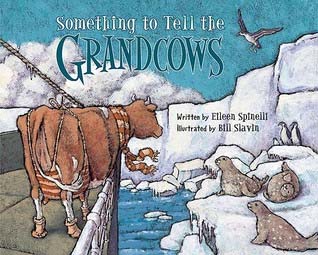
SOMETHING TO TELL THE GRANDCOWS by Eileen Spinelli and THE TWO BOBBIES: A True Story of Hurricane Katrina, Friendship and Survival by Kirby Larson and Mary Nethery

This month we had our first ever virtual meeting of Book Chat Thursday on Zoom. We had eight participants and a lively discussion. With libraries and book stores closed, we did not attempt to read books ahead of time. Instead, Ann Paul chose two books off her shelf and read them aloud, showing the illustrations via a second screen. The first was Something to Tell the Grandcows by Eileen Spinelli, illustrated by Bill Slavia, a fictional telling of a true event. We loved the way the cow conveyed her emotions and excitement of the adventure and at the same time was very cow-like. We also liked the inclusion of so much information about the trip and Antarctica–what they brought (suitcases, building material, even a ukelele) and what they saw (icebergs, seals, endless sunshine in summer and endless nights in winter.) We liked the language of the story and the illustrations that paralleled the light-heartedness of the text. Here’s a link to an article about the actual expedition: Cows in Antarctica

Our second book was The Two Bobbies: A True Story of Hurricane Katrina, Friendship and Survival by Kirby Larson and Mary Nethery, illustrated by Jean Cassels.  This book tells the true story of a dog and a cat, both without tails, who got left behind during Hurricane Katrina and after fending for themselves for four months, finally found a friend at a construction site, and eventually a permanent home. We liked how the story depicted the friendship of the two animals and the way they helped one another. This book felt much more matter-of-fact than the first story. We discussed whether it would be shelved with fiction or nonfiction in the library. Some felt that it was fiction because no one knew exactly what happened to Bob and Bobby before they were rescued; others felt that as a true story, it should be classified as nonfiction. In any case, we felt that young children would enjoy hearing this story of friendship and learning more about the impact of Hurricane Katrina.

Thursday, July 11, 2019

ME AND MOMMA AND BIG JOHN by Mara Rockliff and THE 57 BUS by Dashka Slater

At our July meeting we discussed our picture book first: Me and Momma and Big John by Mara Rockliff. We all loved this book! We loved that it highlighted a female worker/artist who was a stonecutter, one of the many 'little people' who actually do the work to create landmarks, and whose hand cut stone was ultimately hoisted high up on the front of the Cathedral Church of Saint John the Divine in New York City ("Big John") We loved the illustration that showed where 'her stone' was finally placed on the facade. We loved the authentically childlike voice of the storyteller -- a young boy who knew that his mom worked hard every day and did very important work. We loved his pride in his mom's work, and his wish that she be adequately honored for it, as well as his description when he entered "Big John" for the first time and was amazed by its size. We loved the illlustrations, and were astounded to learn that they were entirely done on a computer...they looked like original paintings! We also appreciated the information in the 'back matter' which explained more about this historic church, and the apprenticeship program that hired many young workers and taught them the art of stonecutting. We learned that it was inspired by Carol Hazel, a young mother who actually did this work.

We all felt that our 'novel' -- a nonfiction book, The 57 Bus by Dashka Slater -- contained a very important story. We agreed that it was excellent journalistic writing, and a few readers felt that it had literary qualities as well. The story of Sasha, an agender teenager who liked to wear skirts and Richard, a fun-loving, 'goofy' 14-year-old boy who set Sasha's skirt on fire -- on an Oakland, CA bus -- raised so many issues about identity, teen-aged behavior, accepting consequences for one's actions, the juvenile justice system, and the importance of support from family and other adults. We loved the fact that the students in their respective high schools united in support of both of them. We thought it would be very accessible for young readers because of the very short (often just 1- or 2-paged) 'chapters' which alternated between Sasha's and Richard's stories. One reader stated that her 8th-grade granddaughter had read and loved this book, and said that she vacillated between rooting for Sasha and/or Richard while reading it. We were pleased to know that Sasha survived and is now a university student, and that Richard, who had written an early letter of apology that was not delivered until after his trial, will be released from custody soon, after serving his 'time' in juvenile detention taking classes, learning, and exhibiting exemplary behavior. We all wish him well in the future. We also liked the Glossary, early in the book which defined the various terms for gender, sex, sexuality, and romance. We thought it was a timely story, well-told.