WELCOME

WELCOME! For the last 19 years, about once a month, usually on a Thursday evening, a group of writers, illustrators, teachers and librarians meets in the Los Feliz area of Los Angeles to discuss children's books. Lately we have started meeting at lunch time, once every three months. Usually we talk about one picture book and one middle grade or YA novel. After the meeting, Sandy Schuckett, a retired LAUSD librarian, summarizes our discussion. Here are her reports of our thoughts about the books we have read. We'd love to have your comments too!
Thanks to Nancy Hayashi for our wonderful title art! NOTE: We are changing to a new schedule. Our meetings will now be quarterly and during the afternoon. Our group has been meeting since 2007. It was organized under the auspices of the Children's Literature Council of Southern California (CLCSC).

Showing posts with label Sara Pennypacker. Show all posts

Thursday, February 23, 2023

CURVE AND FLOW: The Elegant Vision of L.A. Architect Paul R. Williams by Andrea J. Loney and CLEMENTINE by Sara Pennypacker


We began our discussion with our picture book, Curve & Flow: The Elegant Vision of L.A. Architect Paul R. Williams by Andrea J. Loney. We all agreed that the digitally created illustrations by Keith Mallett were stunning and elegant, and that it was a very good pairing of artist and author. We felt that the issue of race, as African-American architect Paul Williams was confronted with many challenges -- 'walls' of discrimination that he had to conquer -- was treated with grace and delicacy, while clearly providing the necessary message to readers. We mostly liked the exposition and language of the text, except for a couple of readers who felt that the use of "But" at the beginning of several sentences was excessive. We also questioned the title "Curve & Flow," which was also repeated extensively as Williams' story was told, since -- other than the iconic Theme Building at Los Angeles International Airport, which IS 'curvy' and 'flowy' -- the majority of Williams other architectural creations are quite linear. We thought this might be misleading for young readers. We thought  it was a definite plus that this book covered Williams' entire life, which is very rare for even a 44-page picture book bio, since his early life with a loving family who adopted him after both parents died from lung-related illnesses was as important to who he became as were his later degrees and experiences. We wholeheartedly approved of the excellent Back Matter, which included an author's note, an extensive timeline, a list of sources, and photos of several Williams buildings. We all agreed that it was important that this book about a Los Angeles notable (for a change!) is out in the world, and that it would be a great read for all kids -- probably 3rd grade and above -- a definite inspiration for young Black readers, as well as an excellent example for all of persevering one's dream.


We had a great discussion about humor after reading our novel, 
Clementine by Sara Pennypacker, illustrated by Marla Frazee. All but one of us loved it for a variety of reasons, but one reader -- not so much. She thought it was thin, boring, lacked richness, somewhat colloquial, and not so funny. She felt that although it would probably serve to get kids into reading 'longer' books, she preferred books with role models who weren't always getting into trouble through their actions. Others of us loved the book entirely. We thought it was a well-edited, heartwarming, reassuring, tightly written book without a wasted word, and that Marla Frazee's lively black ink drawings worked perfectly with the text. We thought the vivid details of Clementine's narrative of her 8-year-old daily life were entertaining, and several of us were reminded of female heroines from books of earlier times like Eloise and Ramona Quimby. We loved the way Clementine's arty, energetic parents honored her 'out-of-the-box' way of looking at the world, as they surrounded her with love. We came to the conclusion that each reader has a different conception of what is actually funny; it can depend on age, culture, life experiences, and view of the world. We felt that Pennypacker really knows her audience of young readers, and that -- given the book's popularity -- they are eating it up.

Thursday, May 26, 2016

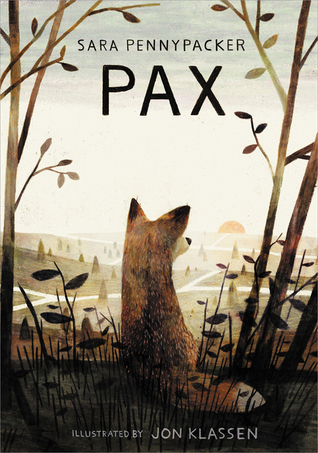
FOUND by Salina Yoon and PAX by Sara Pennypacker

We had quite animated discussions at our May meeting. We talked about the picture book, Found by Salina Yoon first. We all loved the illustrations and the simplicity of the story of a little tricycle-riding bear who finds a toy stuffed bunny in the forest, tries to find its owner, but then becomes very attached to the bunny, and ultimately has to return it to its original owner, a 'grown-up' necktie-wearing moose. We felt that it would be a good read-aloud, and might be helpful for kids who had to get rid of unused or outgrown toys. A couple of people loved the book, but a few others felt that it fell short in a few respects. They thought that the transition when the 'older' moose decided to give the bunny back to the little bear was a bit too 'convenient,' and that it would have worked better if there had been a couple of 'beats' between the moose reclaiming his bunny and then almost immediately returning it back to the little bear. But we basically liked it, and everyone loved the endpapers, which showed a colorful collage of various 'LOST' signs (and one 'FOUND' sign!), some of which would have garnered a good giggle from any adult reading this book to a little one.

We had several differing opinions on the novel, Pax by Sara Pennypacker, the story of 11-year-old Peter, who lived with his widower father, and had rescued a young orphaned fox from the forest, raised it as a pet, and then had to release it back to the wild when his father went to war and Peter was sent to live with his grandfather. The story is told in alternating chapters in the voices of Peter and the fox, as they are each determined to do whatever it takes to find the other, and as each has various harrowing adventures and adverse situations to overcome in the process. Many readers were upset and even a bit annoyed that there was no specific time or place for this story. Which war? Where? When? Others felt that didn't really matter since the major themes were related to letting go of something loved and then trying to find it again, and also to the idea of what really constitutes a family as well as the anti-war message provided in many of the passages that dealt with what war does to people (and animals.) Some readers felt that the author tried to undertake too much in the development of too many plot points, and others felt that both Peter and the fox seemed to exhibit just too much thought and insight given their ages and statuses (11 & a fox!) in life. Many felt that the character of Vola, an embittered female war veteran whose cabin Peter finds in the middle of a forest and ultimately befriends, was somewhat gratuitous, and really unnecessary; others thought she filled an important role in sort of substituting as a mother figure for Peter when he needed that. We all agreed that the black and white illustrations by Jon Klassen added absolutely nothing to the story, and we also all agreed that this book provided some beautifully written passages, and a lot of 'stuff' for us to think about, but none of us felt that it would become 'a beloved classic', as many of the reviews  had stated. ....and so it goes.