WELCOME

WELCOME! For the last 19 years, about once a month, usually on a Thursday evening, a group of writers, illustrators, teachers and librarians meets in the Los Feliz area of Los Angeles to discuss children's books. Lately we have started meeting at lunch time, once every three months. Usually we talk about one picture book and one middle grade or YA novel. After the meeting, Sandy Schuckett, a retired LAUSD librarian, summarizes our discussion. Here are her reports of our thoughts about the books we have read. We'd love to have your comments too!
Thanks to Nancy Hayashi for our wonderful title art! NOTE: We are changing to a new schedule. Our meetings will now be quarterly and during the afternoon. Our group has been meeting since 2007. It was organized under the auspices of the Children's Literature Council of Southern California (CLCSC).

Showing posts with label Sophie Blackall. Show all posts

Thursday, August 17, 2023

THE BEATRYCE PROPHECY by Kate DiCamillo and THE SECRET CODE INSIDE YOU: All About Your DNA by Rajani LaRocca


At our August meeting we began with our novel, The Beatryce Prophecy by Kate DiCamillo and illustrated by Sophie Blackall. Most of us had varying degrees of love for this book for a variety of reasons. We all appreciated the seemingly very simple, but actually very deeply thought out text, which at times felt like a fairy tale and at other times felt even biblical. We appreciated DiCamillo's amazing storytelling skill, and w
e also felt that the black/grey illustrations done with "real and digital pencils" were entirely appropriate. We were enamored by Beatryce, who, during the medieval times in which she lived, was destined, according to an ancient prophecy, to become king. Beginning when she is found in a pen with a goat, Answelica, and with amnesia, the story goes on to explore her quest to find out who she really is, and to find out what her place is in the world. There are so many details that become evident as the story proceeds -- too many to mention here -- but the main one is that she knows how to read and write, which is prohibited for girls in the time she is living. With the help of a monk, Brother Edik; a boy, Jack Dory; an ex-king, Cannoc; and the goat, Beatryce's perseverance leads her through many hairy adventures en route to the palace. We loved the way that the story developed as we learned the reasons that each character joined her quest; we loved the suspense, and the final resolution, which made a reader feel the power of love as well as the power of story and the importance of reading. One reader was less enamored of the book, and although she did like the story and the writing, she felt it might be a bit too didactic as far as Beatryce's strength as a female and the importance of reading were concerned. We all felt that young readers would become fully engaged in this book from the very beginning, and that since it is a relatively easy read (and not too long) they would stick with it until the end -- where they could not help but to feel -- something!


We decided to read The Secret Code Inside of You: All About Your DNA by Rajani LaRocca and illustrated by Steven Salerno because we had loved her writing in Red, White, and Whole, which we discussed in July. We wanted to see what she would do with a nonfiction picture book for younger readers. We had varying opinions on this book whose role was to simplify the very complicated subject of cells, DNA, chromosomes, genes, and how they all create specific  characteristics in humans and animals. Some of us liked the rhyming couplets that comprised the text throughout the book, others thought they were terrible, and that the introductory part of the book -- before getting into the actual science -- was too long. We all basically liked the illustrations, which were quite colorful, and did show what the text talked about -- like the cell and the double helix of the DNA. One reader felt that this book was terrible -- that it wasn't totally scientifically correct, and that it was poorly written. But most of us felt that kids could definitely learn from it but probably would be unlikely to just pull it from a library shelf.  However, if a teacher or parent read it to them and showed them the pictures they might want to read it again themselves, and might even want to read more books about this topic. We did feel that the back matter of the book was helpful, but probably for adults -- since young kids rarely read it. 

Thursday, March 31, 2016

FINDING WINNIE: The True Story of the World's Most Famous Bear by Lindsay Mattick and A CROOKED KIND OF PERFECT by Linda Urban

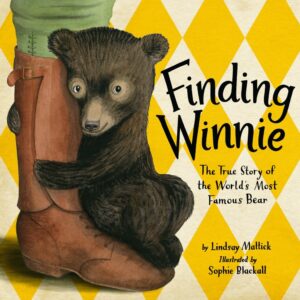
We began our last meeting with a discussion of the picture book, Finding Winnie by Lindsay Mattick and illustrated by Sophie Blackall. Although we all came prepared to say quite good things about this book, one of our members produced and then read aloud to us another book on the exact same subject/situation: Winnie: The True Story of the Bear who Inspired Winnie the Pooh, written & illustrated by Sally M. Walker. Wow! It ended up being a 'compare and contrast' discussion between these two terrific, but very different picture books which told the story of a real bear cub who was purchased for $20 in Canada, accompanied Harry Colebourn, a veterinarian for the Canadian army to a camp in Europe during World War I, and ended up in the London Zoo where she was discovered by Christopher Robin and his father A.A. Milne. We felt that the first book, presented as a story being told to Colebourn's toddler-looking great-great-grandson, Cole, was sweet in intention with some quite poetically written passages, but that the many interruptions where Cole's mom was actually telling him the story were annoying and broke the mood of the actual story of Winnie. In the second book the story was told in a matter-of-fact, well-written, linear style, and contained many more details about Harry and Winnie, and we felt it would be better understood by young readers or as a read-aloud. It also contained back matter that provided many more details, which the first book lacked. We liked the illustrations in both books for various reasons, although we felt that a couple by Blackall (in the first book) didn't maintain the same mood as some of her others did. We also liked the fact that both included a ' photo album' format: presenting actual photos of Harry, Winnie, the soldiers, C. Robin, and even Milne that gave complete credence to Winnie's story. Finally...we discussed the fact that when Winnie was in the London Zoo, children (including CR) were allowed to come into her cage and play with her!! This would obviously never happen today, and we talked about the concept of 'adopting' wild animals, and how this wasn't such a great idea for 'regular' people. A couple of people felt that there should have been a "don't try this at home" caveat. Verdict: two very different, but quite good books on an interesting subject.

We all liked the novel, A Crooked Kind of Perfect by Linda Urban. We felt that although the family in the story could have been perceived as dysfunctional, with an unemployed dad who didn't like to leave the house and was basically afraid of people, a workaholic mom, and the 11-year-old protagonist, Zoe, who pretty much had to fend for herself, the story was actually very positive as it showed how these three people loved, understood, and truly communicated with each other...although probably in quite nontraditional ways. We all agreed that at first we didn't much care about what was going on -- Zoe wanted a piano but got an old model electric organ; she entered a competition; she worried about whether her parents would attend; she had a weird friend who followed her home an hung out in the kitchen baking with her dad...etc., but that as the story developed, we began to care more and more about Zoe, and were all in her corner. We felt that Zoe's voice was authentic as she continually learned about getting along in the world, where although things aren't always what you hope for, they can end up good anyway. We loved the character of Wheeler, Zoe's schoolmate who had connected with her dad, and was almost a mentor/cheering section for him, and although one of our members thought it was completely predictable, we mostly liked the way the story ended with her getting a piano and her dad getting a job that he could handle. Pretty much positive feelings all around, and we enjoyed reading a book without a lot of angst and insoluble problems (for a change!)