WELCOME

WELCOME! For the last 19 years, about once a month, usually on a Thursday evening, a group of writers, illustrators, teachers and librarians meets in the Los Feliz area of Los Angeles to discuss children's books. Lately we have started meeting at lunch time, once every three months. Usually we talk about one picture book and one middle grade or YA novel. After the meeting, Sandy Schuckett, a retired LAUSD librarian, summarizes our discussion. Here are her reports of our thoughts about the books we have read. We'd love to have your comments too!
Thanks to Nancy Hayashi for our wonderful title art! NOTE: We are changing to a new schedule. Our meetings will now be quarterly and during the afternoon. Our group has been meeting since 2007. It was organized under the auspices of the Children's Literature Council of Southern California (CLCSC).

Showing posts with label mg. Show all posts

Saturday, April 4, 2026

I KNOW HOW TO DRAW AN OWL by Hilary Horder Hippely, and THE TEACHER OF NOMAD LAND by Daniel Nayari


We started by discussing our picture book, I Know How to Draw an Owl by Hilary Horder Hippely and illustrated by Matt James. Several of us loved everything about this short story told by a homeless little girl, Belle, who had seen an owl one night while standing outside of her mom's car where they had been sleeping, and she felt that the owl was welcoming them to its forest. In school, her teacher shared Belle's drawing with the class as an excellent example, but Belle couldn't talk about why she drew it that way. We loved the subtly poetic language, and the emotion that was evoked by the art, much of which was shown on large wordless double-page spreads, often preceding the next action --an illustrator's challenge well met. We liked how Belle's 'flashback' was presented in a way that worked, which doesn't usually happen in picture books. A couple of readers weren't as thrilled with the book, and didn't love some of the rhyming, but we all agreed that it presented a very realistic depiction for youngsters showing them what it's like to be homeless. We all loved the ending, where Belle welcomes a seemingly sad new boy to her class, after seeing him get out of a car with a large black trunk strapped to the top. It was only then that she decided to tell her story.


Our novel, The Teacher of Nomad Land by Daniel Nayeri made for a very lively discussion, since there were so many different points and issues to discuss in this saga of Babak and Sana whose father, a teacher had just died, leaving them orphaned in 1941 during World War II. They determined to join a group of nomads who made annual seasonal treks from one part of Iran to another and had established a well-organized plan for setting up camp and surviving with what the land gave them. Some readers felt the first three chapters were too slow, while others felt that they set up some of the reasons why the two siblings made the decisions they did. We all liked the descriptions of the land, of nomad life, the relationship between Babak and his younger -- but very alert and precocious -- little sister, some of whose ideas and decisions saved their lives. 
We all liked the themes of the story: the importance of language, learning, and communication between people who are different, the relationship between the two siblings, the reverence for what their father had taught them, and finally, the author's notes at the back which further explained Iran's role during World War II. 
 
 
There were too many details in this story to recount here: the process of teaching a language; a 'bad guy' character; Ben, a Jewish boy fleeing a Nazi spy; the Nomad's leader. Through some harrowing adventures, some of which seemed beyond belief, the two made it to a uplifting, safe ending. Some readers questioned various parts of the book: the sister was 'too smart for her age'; the description of Ben seemed stereotypic; many of the plot points never could have possibly happened in real life; there were too many coincidences. But others felt that young readers in the target age group (grades 3-7) would be mesmerized by the suspense of a story where the children were the stars and their ingenuity and knowledge helped them to solve problems as they arose. 

Monday, December 15, 2025

PAPER SON by Julie Leung and PIE IN THE SKY by Remy Lai


We had a great meeting with lotsa great 'pot luck' dishes, a terrific discussion, and just fun being together. We began with our picture book, 
Paper Son by Julie Leung; illustrated by Chris Sasaki. We all felt that this story of Tyrus Wong, a Chinese-American who immigrated to the U.S. as a 'paper son', and went on to become a noted painter in multiple media who created all of the scenery for the 1942 world-famed Bambi film and as an older man a noted maker of Chinese-style 'flying' kites . We all agreed that this was an important story to know, and some were surprised to know of Wong's history with the Walt Disney film. But we had mixed feelings as to the book itself. A couple of readers liked the beginning pages that depicted young Tai Yow's entry at Angel Island and early days as a Chinese immigrant who had to lie about his identity in order to be admitted to the U.S., and whose name was Americanized to "Tyrus" by his teachers in his Sacramento school. We liked how it depicted his early talents in art, and how he used many Chinese art techniques in his work, even as a young boy. But many of us felt that as the story of the events of his life continued it became more 'adulty' with less emotion, and that a better-written story would have been more interesting to young readers. We all liked the illustrations, and were surprised to learn that they had been done digitally by Sasaki. But we did note the emotional feelings they evoked, as well as the very subtle portrayals of the prejudice Wong experienced from the moment he arrived and as he continued to function in the American environment of his time. We wished there had been more about Los Angeles during that time, which is where Wong had settled, as well as more about his family, who were only shown in one photo in the Back Matter of the book. We wanted to know more, and were sorry that the Author's Note basically repeated the story in the book, and provided no more details for readers. We felt that this book would have many uses at different grade levels -- as an introduction to the life of an important Chinese-American artist, and for art teachers or for class discussions related to immigration and the feelings of new immigrants in our country.


We also had mixed feelings about our novel, Pie in the Sky by Remy Lai. Although it had been billed as a 'humorous' book, many of us did not feel there was much humor...except maybe in Lai's 2-color cartoon-like depictions of many scenes in the story between 12-year-old Jingwen and his 9-year-old brother Yanghao, who had been taken by their mother from an unnamed country to Australia after their father, a bakeshop owner, had died in an auto accident. We wished we knew where they came from and why they chose to move to Australia. We liked the fact that the story dealt with the issues of relocation, not knowing English, not really having friends, sibling rivalry, lying to his mom, etc., but -- we felt that this had been done so many times before, and this book added nothing new, and could have been shorter. The crux of the story (and what made it so long) was that the brothers tried to bake the 12 different cakes that Jingwen felt  could honor his father, but we never really knew why. (...and we wished there had been recipes!) Some of those situations were implausible, and details here would make this recap too long also. We felt that by the time we got to the end of the book (which a few readers couldn't even finish) we were tired of the baking scenarios, and the 'climax' of WHY Jingwen wanted to do that was finally revealed. We did, however, agree that young readers would probably like this book, many of whose pages resembled a graphic novel, and that the humor in the illustrations might keep them reading. It wasn't a bad book; just not a thrilling one.

Tuesday, September 30, 2025

TREE. TABLE. BOOK. by Lois Lowry and CLEVER CROW by Chris Butterworth


We had a great meeting on Sept.18. We discussed our novel, Tree. Table. Book. by Lois Lowry first. We all agreed that Lois Lowry, who has published more than 40 books for young readers, still 'has it' and knows how to create a good story and keep readers engaged. However, a few readers were bored by the beginning and felt that this book started too slowly, and they were not really interested in knowing so many of the details of middle-schooler Sophia's life in small town-New Hampshire. Others of us thought Sophia's voice was perfect, and knowing all these details about her enhanced our understanding of her relationship with her 88-year-old neighbor Sophie who liked many of the same things she did, and shared an offbeat sense of humor...even as she was entering the early stages of dementia. But we all agreed that Sophie's stories, as she was being put through various memory tests by her information-gathering young friend, were the most engaging part of the book, and that she was actually the star of the story. We also appreciated the depth of Sophie's memories as she told of her early life during what was obviously the beginning of the Holocaust -- prompted by three words: Tree. Table. Book. We also liked the depiction of the relationship between young Sophia and her best friend Ralphie, and the way they dealt with another little boy, Oliver, who was brilliant, quite eccentric, and appeared to be on the Autism syndrome -- although it was never necessary to mention that by name. We loved that the kids were very sensitive to him and to his needs, and were protective without trying to change him. The only thing we all felt could have been left out was a whole section about an abandoned house that Sophia imagined they could smuggle Sophie into when her son wanted to move her to an assisted living facility. We talked about several more of the details from this story, but to add them here would make this Recap almost as long as the book. We agreed that the ending was plausible, and probably the best outcome for all. Some readers wondered about the target age group for this book, since they felt that kids that age wouldn't know anything about the Holocaust or Autism. But others of us thought that didn't really matter, since it was the understanding,  humanity, sensitivity, and love between these two almost identically-named females -- one young, one old -- that were the strength of this engaging story.


Our discussion of our picture book, Clever Crow by Chris Butterworth was significantly shorter! We all liked the mostly-shades-of-grey-and-black illustrations by Olivia Lomenech Gill, which -- though very accurate --were not actually photographic. But many of us felt that they would have been even better with more color. Our main problem was with the text, which didn't flow in any meaningful way, and merely contained random facts presented in a dully-written manner. We couldn't really figure out why various parts of the text were presented in differently sized fonts -- from 'normal' for the 10"x10" large page size to larger to huge. However, we did feel that this book could be useful in a school setting for any primary class studies of different types of birds. We especially liked the end papers: the front ones showed pictures and relative sizes of various crows' family eggs; the rear ones showed very accurate depictions of the various birds in the crow family. Many of us had not been aware of most of them! And the short 'lesson' for using an Index shown at the very end of the book could also be very helpful in a classroom.

Thursday, May 8, 2025

ONCE UPON A BOOK by Grace Lin and Kate Messner and THE TENTH MISTAKE OF HANK HOOPERMAN by Gennifer Choldenko


We were all glad that we had two winners for May! We began with our picture book, Once Upon a Book by Grace Lin & Kate Messner. We loved the illustrations and the story of a little girl, Alice (!!) who is bored on a rainy day and is beckoned by a white rabbit to join him inside the pages of a book, where she is invited to 'turn the page and come in' by a variety of animals (and some clouds) who share their humid, rainy, hot, wet, airy, stormy habitats with her. Each page turn leads to another experience in another place, ending up in the sky, close to the moon, but when she has had enough, Alice is invited to a place of coziness and warmth -- home! -- and a loving family and a bowl of dumplings is there waiting for her. We loved how the white rabbit was shown on ever page, as well as the other details in the very brightly-colored
 gouache paintings.  A couple of readers thought the text wasn't so interesting, but others felt that young readers/listeners would enjoy the repetition and would soon 'join in' as the story progressed. We also felt there were many details in the illustrations that lent themselves to further discussion. This book was seemingly an homage to Alice in Wonderland and Where the Wild Things Are, and we were sure that young readers would enjoy it.


Many of us felt that our novel, The Tenth Mistake of Hank Hooperman by Gennifer Choldenko, had a very slow start, and looking at the cover illustration we feared it might lead to the (now very common) trope of the travails of middle school. But! -- NO! We were all ultimately captured by this very compelling story of 11-year-old Hank and 
his 3-year-old sister, 'Boo', whose mother has left and after a week still hasn't returned. The kids are hungry and scared, and the remainder of the story centers around Hank's resourcefulness as he tries to find a way for both of them to be safe, and ultimately to have a good normal life. We thought all of the characters were well-drawn, and we loved the realistic voice that put us inside of Hank's head as his devotion to his little sister and his resilience led him to trust other adults throughout the twists and turns of the plot. A couple of the readers felt that some of he middle part of the story meandered, and perhaps could have been shortened. We thought young readers would stay engaged in this heart-warming, life-affirming story, and that it needed to be on every library shelf, because of its realistic treatment of a situation in which, sadly, many youngsters find themselves today.

Monday, December 16, 2024

DO YOU REMEMBER? by Sydney Smith and STELLA DIAZ HAS SOMETHING TO SAY by Angela Dominguez


At our November meeting we discussed our picture book first, Do You Remember? by Sydney Smith. We all liked so many things about this book: the contrast between 'then' and 'now' as a young boy and his mom go through various memories of their lives after -- as we learn later -- they are no longer living with the dad of the family. We thought the gentle structure of this spare story was perfect for its purpose -- the idea of reliving memories as a bedtime story activity. We agreed that it had quite deep meanings, and appreciated the difference between the mom's and the son's recollections of the same events. The fact that each of their voices was presented in a different color text was quite helpful, and the illustrations helped us to know exactly what each was remembering. A couple of readers experienced this book via YouTube, and it was obvious that it didn't come across as clearly as if one was reading the actual book, since the visual elements were very important to the story, even including the different colors of endpapers: light in the front and dark at the end. We appreciated that the reader was left with the idea that these twol, who now lived in a new place would be making new memories -- helped by many of the pictured articles brought with them from their previous life.


We had differing opinions of our novel, Stella Diaz Has Something to Say by Angela Dominguez. We all agreed that it was too long, and could have used better editing. After that, our discussion boiled down to this:

Pros: It was a nicely done story (even tho' too long); parts of it were interesting and the characters seemed real; it provided good insight into one particular family while at the same time being a universal story of a timid young girl gaining confidence as the experiences of her life in school and at home and with friends helped her learn more about being in the world and finally feel free to speak her mind.

Cons: The writing felt somewhat tepid and flat -- one reader felt it was boring; another felt the story was not engaging and contained "no engine" and "turgid pacing"; some wondered why this book had received an award for Humor, since they didn't find much funny in it at all.

This discussion was a perfect example of the joy of our book group...the fact that each reader brings something different to the experience, therefore producing different reactions after reading a book. The same is true of young readers, and we felt that some young readers might really like and relate to this book while others would become bored and put it down. ...and so goes the world!

Friday, May 10, 2024

THE LIST OF THINGS THAT WILL NOT CHANGE by Rebecca Stead and FARMHOUSE by Sophie Blackall


We started with our novel, The List of Things That Will Not Change, by Rebecca Stead. We had mixed reactions to this book. A couple of readers liked it a lot -- mostly because of the true-sounding voice of ten-year-old Bea who had many issues to deal with: her parents' divorce, living in two homes, her dad's impending marriage to a man, which would entail a new sister, and also the usual problems that seem huge to kids of that age. We thought all of the different events were described realistically, and liked the fact that even though a gay marriage was involved, this wasn't an "issue book" per se. We liked the co-parenting of her mom and dad, and the other adults in her life who were helpful to her. Other readers felt differently: it was too long; it had too many things to deal with; they could not relate to Bea at all. We felt that many young readers would probably become involved in the story, and that it was a pleasant and comfortable read for them.


We all loved the illustrations in our picture book, 
Farmhouse, by Sophie Blackwell. We appreciated the detailed depictions of almost everything that was mentioned in the text, as a large farm family (12 children!!) proceeded through the daily work and play on a farm in Upstate New York. We watched time pass as they all grew up and left the farm until only the youngest sibling, "now quite old" finally left. We watched the house and the things inside of it deteriorate, until it was finally 'rescued' by the teller of the story. Some readers felt it was an 'old-fashioned' picture book...with 'real' illustrations that bucked the seemingly current trend of more 'cartoon-like' depictions in books. We thought it would be a good book to share in a 1:1 situation between an adult and a child, where they could point out individual details in the family's possessions, and perhaps compare them with things they were familiar with in their own houses. A couple of readers were not so thrilled with the actual text, which attempted to be poetic, but sometimes wasn't, but we all agreed that the last lines of the story, "...twelve children...loved and grew quite old, where they'll live on, now, in this book that you hold, like your stories will, so long as they're told." This ending created a few lumps in throats. We appreciated the end papers, different in the front and back of the book, which gave the flavor of many of the details in the book, and included a full page AUTHOR'S NOTE in which Stead told all of the details of this farmhouse that she actually bought, researched, and refurbished. We had some discussion about the issue of younger people who grew up on family farms having no interest in continuing their parents' endeavors as farmers, as well as what the loss of these single family farms has done to the food chain of our country. We thought it was a good book, and we were glad we had read it.

Thursday, February 8, 2024

A WORK IN PROGRESS by Jarrett Lerner and HOT DOG by Doug Salati


We had a great group and good discussions at our February meeting. We started with our novel, A Work in Progress by Jarrett Lerner. We all mostly had varying degrees of 'Like' for Will's first-person account of his agony that started with his first being called "FAT!" by a bully in fourth grade, and how it continued to affect him even in middle school where he tried to make drastic changes in his eating habits in order to 'fit in' and attract and keep friends. We all remembered the things that had been said to us when we were quite young that continued to bother us many years later. Initially we were all a bit daunted by the 362-page heft of this book, but the format of very short free verse text and many full-page drawings in a facsimile of Will's lined notebook made it a quite speedy read. We thought it was an important story that dealt with bullying, body-shaming, eating disorders, and self-acceptance, along with the usual middle-school angst. We wondered which kids would read it: overweight kids? kids with overweight friends? parents/teachers of overweight kids? We also wondered how an adult might comfortably place this book in the hands of a kid who might really benefit from reading it -- and who also might be able to learn, through the events in Will's story, how to best cope with their own situation and begin to accept themselves for who they really were. We agreed that perhaps presenting it to a whole class would encourage a variety of young readers to at least pick it up and look at it -- and perhaps read the whole thing, given its quick-read/multi-illustrated format. Upon learning more about the author, we were pleased to know that it was his own story, and not just some "...oh! I'll write a popular issue book" situation. We were sure that young readers who started it would definitely want to finish reading the whole book.


We had varying opinions on our picture book, Hot Dog by Doug Salati. One reader was expecting it to be about actual hot dogs, and was disappointed that it was merely about a dog in a big city (probably New York?) who hated the hot summer and the noise and confusion and was thrilled when his owner, who was tuned into his feelings when he plopped himself down in the middle of traffic and refused to budge, took him on a short cruise to a nearby island where he could enjoy the sea breeze, romp on the beach, and cool off in the water and gather pebble and shell treasures to take home. We liked the detailed illustrations, which told most of the story, where the dog himself was portrayed as short, reddish-brown, and yes, sort of 'hot dog-looking'! One reader was not so thrilled with the scant text, and felt that had the text alone been sent to a publisher perhaps it may have not even been published. But we felt it could be a fun read-aloud, and that anyone -- adult or young child -- who had ever spent a hot summer in a big, noisy city could empathize with this nameless hot dog and dream of a wonderful day at the beach.

Thursday, December 14, 2023

CINNAMON by Neil Gaiman and THOSE KIDS FROM FAWN CREEK by Erin Entrada Kelly


We all loved Divya Srinivasan's authentic India-themed illustrations of our picture book, Cinnamon by Neil Gaiman. Long ago a Rajah and a Rani had a daughter, princess Cinnamon, who was not only blind, but also did not talk, and they offered a mango grove, a parrot, and a portrait of the Rani's aunt, once a raging beauty, to anyone who could teach their daughter to talk. All failed except for a ferocious tiger, who (amazingly!) could talk, and who taught Cinnamon about pain, fear, and love. It turned out that Cinnamon never talked because she had nothing to say, but learning about the world from the tiger made her want to go away with him "...for a while to further her education." We all loved that! Some of us loved the writing and the humor in the telling, others not so much; some felt the story was too dark, others remarked that most fairy tales have dark elements; some felt it was too simple or too fantastical. The written and illustrated details that made the story enjoyable are too numerous to mention here, but worth a look. We did feel it could be a good read aloud, and could be used with students alongside other traditional tales with similar motifs.


None of us were thrilled with the title of our novel, Those Kids from Fawn Creek by Erin Entrada Kelly, the story of a strange newcomer, Orchid, a seemingly ethereal girl, who arrives to join a very entrenched group of 12 seventh graders who have been together since kindergarten in Fawn Creek, a tiny Louisiana town. As Orchid begins to affect the long-held behaviors of the other kids via her positive attitude, everything seems to be thrown into turmoil. The story, told from many points of view, deals with several of the usual issues among kids of this age: cliques, 'mean girls,' crushes, friendship, gender roles, bullying, lying, etc. etc. etc. Some readers thought the different points of view as the story progressed were confusing, but others pointed out that the drawings at the beginning (as if on a yearbook page) made it easier to figure out who each kid was, and why each of their descriptions/actions/feelings made sense. Some thought that it would have been good to read Orchid's point of view also, but that never arose. Some thought it was a psychological study of kids' thinking/reactions at that age but not so thrilling to read. Others felt that young readers in the target group would certainly relate, and that it was a quick read, including moments of suspense, which kids would also like.

Monday, November 13, 2023

SMART COOKIE by Elly Swartz and THE GARDENER OF ALCATRAZ by Emma Bland Smith


We began our November discussion with our novel, Smart Cookie by Elly Swartz. We had several issues with this book. Although we thought that the major plot point, Frankie's efforts to find a mate for her dad online after her mom's death in a thunderstorm, was a good idea, but it lacked depth. We felt that there was just too much other stuff happening -- ghosts, friendship problems, hoarding, rules, secrets, and more that got in the way of the plot and were never properly developed or resolved. We liked the relationship between Frankie and her best friend Elliot and between Frankie and her dad and grandma, but since there was so much other 'mini-plot stuff' to think about none of us really felt anything as the story proceeded. We did agree that young readers of the target age group (8-12) would probably like the book, and anything that keeps a kid reading is good.


We liked both the great opening and the tone of the writing of our picture book, 
The Gardener of Alcatraz by Emma Bland Smith, which told an easily accessible story of Elliott Michener, a convicted counterfeiter, who had been transported from Folsom Prison to Alcatraz, decided to be a 'good guy', and ultimately redeemed himself by tending the Alcatraz garden outside of the prison walls. We thought the engaging story showing that people can change would be good for young readers as they read about Elliott's passion and pride as he learned more about gardening and gained skill. We thought Jenn Ely's illustrations were well done in terms of showing facial expressions, changes in perspective, and the way that color crept into the garden that developed in a previously barren place. We agreed that the back matter, for those who would read it, was helpful in presenting further details about Elliot's life and encarceration, the Alcatraz garden, background on (usually un- or poorly-paid) prison labor, treatment of nonwhite prisoners, and other social issues. We thought the book might be especially relatable for students who had incarcerated parents or relatives, and could present some hope of redemption and transformation through the idea that one is not 'just a prisoner.'

Thursday, September 21, 2023

ATTACK OF THE BLACK RECTANGLES by A.S. King and NANO: THE SPECTACULAR SCIENCE OF THE VERY (VERY) SMALL by Jess Wade


We started with the discussion of our novel, Attack of the Black Rectangles by A.S. King. There were things about this book that we all liked: the fact that it dealt with reading, honesty, and current issues of censorship that are part of the general conversation (sadly/still!) in today's society. But most of us felt that much of the characters' 'dialog' regarding not only the fact that words had been redacted (by their teacher, Ms. Sett!) from The Devil's Arithmetic by Jane Yolen, but also long discourses re: women's rights, treatment of Native peoples by Columbus, Anglicizing a Vietnamese student's name, and other present-day issues turned 6th-grader Mac and his friends into didactic mouthpieces for the points the author wanted to make in this story. We liked the fact that Mac had been exposed to many well-known and excellent examples of children's literature, and we hoped that young readers, upon seeing those titles in this book might want to read the books mentioned. We liked the idea that Mac was encouraged to speak his mind by his mom and his grandpa, and we saw his growth as he and his friends excited the whole community of his small town and brought them on board to protest this act of censorship in front of the school board. We were somewhat puzzled by the additional storyline of Mac's dad: an impulsive, angry, and somewhat dishonest man who was obviously in the throes of some mental illness issues. Mac just wanted to know the truth about his dad, which was being kept from him and prevented him from feeling whole. But -- though the issue of honesty was emphasized throughout this book -- a couple of us felt that the story itself was somewhat dishonest in the way it ended, where the kids won, Ms. Sett promised to not redact any more books, and everyone lived happily ever after. In today's real world it unfortunately wouldn't happen that easily. We did like the emphasis on keeping an open mind and reacting with grace in uncomfortable situations which Mac consciously always tried to do. We felt that young readers would probably like this story of family, friendship, first crush, and frankness.


We had mixed feelings on our picture book, Nano: the Spectacular Science of the Very (Very) Small by Jess Wade. We thought this simplified explanation of the very complicated science of nanotechnology was basically well-done. We liked how it started in an almost poetic way with the very fundamental knowledge that youngsters have about what makes up our world. Some of us felt that when it got into more scientifically detailed explanation the text became less fun to read and seemed more like a very dryly written textbook. Most (but not all) of us thought the strangely colored illustrations were terrific, and we all liked the fact that a little girl was shown on each page exploring whatever the text was attempting to explain. We thought this was especially encouraging for young female readers who were interested in science. We liked the pages at the end that contained even more detailed explanations of nanomaterials and a brief index. We felt that most young readers would probably not pick up this book on their own, but that an adult might alert them to it and that they might enjoy it. We also felt that it was a basic introduction to nanoscience that would be valuable for middle-schoolers and even those in high school.


Thursday, January 26, 2023

THE GREAT ZAPFINO by Mac Barnett and THE WATSONS GO TO BIRMINGHAM by Christopher Paul Curtis


We began our discussion with our picture book, The Great Zapfino (2022) by Mac Barnett, illustrated by Marla Frazee. We all loved the black Prismacolor pencil illustrations, which actually served as the main vehicle to tell this story, which begins with a very few words as "the Great Zapfino" -- a young man/boy (?) climbs a 10-story ladder at the circus, walks out on a platform and then prepares to dive down onto a trampoline. BUT WAIT! -- where is Zapfino? It seems that he got scared and disappeared and after a taxi/airplane/taxi ride ends up taking a job as an elevator operator at a seaside hotel. He even gets his own apartment on the tenth floor! The bulk of the story is told with large and small very sensitive and expressive drawings which show young Zapfino's daily life as it passes between work and making toast and sleeping in a chair at home. The expressions on the faces of the elevator riders are bored/happy/excited/inquisitive/celebratory/amorous/and more, but the expression on Zapfino's face is always...sad. When Zapfino falls asleep in his chair as his burning toaster sets the apartment on fire, he runs to the window, and -- his courage returns and he jumps! he twists! he turns! he dives!-- straight into the firefighters' net. He is a hero! ...and now -- at the very end -- he is smiling as he stands beside his elevator door with a big Z on the front of his uniform! Behold the Great Zapfino! We mostly liked the story as Zapfino found his courage, and did it for himself -- without help from anyone. We thought this might be a good message for young readers. But one reader felt that perhaps it might not be so good for young kids to see the actions in this book. Perhaps it needed a "Do NOT try this at home" disclaimer. We were unsure that it would work as a read-aloud, but felt that youngsters would individually enjoy really exploring all of the visuals as the pictures told the story.


We chose our novel, the
Newbery Honor book The Watsons Go to Birmingham -- 1963 by Christopher Paul Curtis, to see if it still held up 28 years after its original 1995 publication. We decided that it basically does. We all liked10-year-old Kenny's voice as he introduces us to his family by commenting on their lives, daily activities, personal quirks, and some family history. When Kenny's 13-year-old brother Byron, who Kenny describes as an "official juvenile delinquent" has some problems, it is decided that the family will drive from their home in Flint, MI to Birmingham, AL so By can live for a while with his Grandma who will certainly ' 'straighten him out'. It's a long ride, with various incidents, conversations, music, and events that solidify the family further. There is suspense as we learn that on Sunday a "bomb has been dropped" on the church where younger sister Joey has gone -- all dressed up -- to Sunday school, and then Kenny finds her shoe on the street near the church. We thought that it was important for today's middle-grade readers (age 10+) to be aware of this atrocity that occurred on September 15, 1963 at the 16th Street Baptist Church in Birmingham where the KKK planted the bomb that killed four young girls: three who were 15, and one who was 11 years old. We thought the family's reunion back at Grandma's home at the end left a good feeling for the reader. We appreciated that Curtis included an Epilogue, which gave the reader a short historical perspective on conditions in the U.S. South in 1963 and the Civil Rights Movement which was an outgrowth. A couple of readers felt that the story took too long to actually get to Birmingham (since that was the title) while others thought that really getting to know Kenny and his family made the climax and the ending of the book better. We agreed that it was a good read for the designated age group, and that today's kids might want to give it a look.

Thursday, November 10, 2022

PAPA LOVES YOU, TINY BLUE by Jo Empson and SPY SCHOOL by Stuart Gibbs


Our October meeting was a hybrid with three of our members joining us remotely on Zoom. We began with our picture book, Papa Loves You, Tiny Blue by Jo Empson. We all loved this sparely and beautifully told story of Papa Penguin and his very cute baby, Tiny Blue, who had A LOT of questions as they walked along the beach and swam in the ocean. We agreed that anyone one who has had experience with an inquisitive toddler (including the toddlers themselves!) could relate as Papa very simply and clearly explained the wonders of the world around them and the sea in which they swam – until – he finally said, “Aren’t you tired yet?” We loved the ending as Papa answered the final question, “What is love?” We also loved the lush, mostly bluish and pinkish illustrations throughout, which in many places felt very ‘wet’ – especially when they were exploring the underwater areas. We also liked the addendum page at the very end that explained fairy penguins, the smallest in the world, and gave very simple, scientifically true answers to some of Tiny Blue's questions. We felt that this was a great read-aloud/bedtime story that all would enjoy.


We had a 50/50 split in our reactions to our novel, Spy School by Stuart Gibbs. Half of us thought at first that the book would be really great, due to the title and the chapter headings, along with the military-seeming format telling the location, date, and time of the incidents in each chapter. But sadly, these readers were disappointed due to what they felt was a lack of characterization, too much violence, references that they felt were beyond the knowledge of the 8-12-year old targeted readers, and some plot situations that were just too convoluted to tolerate. Those of us who liked this book more appreciated 12-year-old Ben, the protagonist, who, after being brought to the Spy School as a ruse to catch an internal mole, turned out to be a very smart and intuitive thinker and problem solver, even as he was cast into various scary episodes of intrigue along with the usual middle-school angst common in novels for this age group: friends, girls, relating to teachers, food, etc. We also appreciated the fact that the ‘smartest person in the room’ was the very aloof and brilliant Erica, who had an answer and a solution for almost every situation that arose. Even though we didn’t love all of the weapons and violence, we felt that young readers would enjoy reading this first installment (published in 2012) in what is now a series of ten books, and many of us were interested in possibly reading more ourselves to see what happens to Ben, and whether the author’s style and plot ideas have changed at all, given current issues with school violence, guns, relating to authority, and attitudes of today’s youth toward sex. We had a very interesting discussion, and our differences of opinion are part of why we love our group!

Thursday, May 26, 2022

CUBA IN MY POCKET by Adrianna Cuevas and EYES THAT KISS IN THE CORNERS by Joanna Ho and illustrated by Dung Ho


We began with our novel, Cuba in my Pocket by Adrianna Cuevas. We all liked the sensory picture that twelve-year-old Cumba painted of his native Cuba and his loving family and friends -- we could see, hear, feel, smell all that he described of the life he loved but had to leave in 1961 after the Revolution. We also liked his first-hand description of his experiences as a new immigrant in the U.S. -- getting used to a new language, food, people, activities, school, and missing his quite affluent family and his country. We felt that many young readers, immigrants themselves, could relate to this and that non-immigrant kids could get a feel for what some of their fellow-students might be experiencing -- perhaps creating some empathy. We also liked Cumba's voice, and were gripped by his feelings as he had to leave the home he had known in order to avoid being conscripted into the military, and we thought that the tension in the story was well-maintained throughout. We understood the author's need to fictionalize the story of her own father's journey from Cuba to the U.S. in 1961 and were thankful for her note at the end of the story as well as the Glossary of many Cuban terms. However, a couple of readers had mixed feelings about this book, since they were fans of the Revolution, and what it had accomplished for the millions of mostly poor, mostly black, and mostly illiterate Cuban peasants, namely: a 98% literacy rate due to the Literacy Brigade; free education for all; and free health care in every neighborhood. It was noted that the very poor peasants did not have the opportunities that Cumba had, due to his professional parents' knowledge, connections, and wealth. All of that considered, we were all happy that -- in the story -- Cumba's family was ultimately able to join him in Florida in the end. We felt that this could be a very useful book for middle-schoolers to further their knowledge about immigration, trying to 'fit in', and the universal 12-year-old angst that many young folks experience.


We all agreed that the biggest strength of our picture book, Eyes that Kiss in the Corners by Joanna Ho and illustrated by Dung Ho was the group of vibrantly colorful, detailed, and in some places quite fanciful digitally created illustrations that we felt really served to tell the story in the voice of a little girl who compares her eyes with those of her mom, grandma, and little sister. We liked the inclusion of the folkloric/mythic images from the stories her grandma told, and the warm connection between three generations of females. We felt that much of the text was glowing and poetic, but that other parts were a bit overwritten. We had a hard time determining exactly where this story took place, and would have been very thankful to have been able to read an Author's Note with further details. We loved the fact that the story (and the title) placed value on something that has been de-valued -- the eyes of people with Asian ancestry -- and the fact that this very short picture book served to define their beauty. We thought it could be a great read-aloud, and gave it a 'thumbs-up'!

Thursday, April 28, 2022

DOUBLE BASS BLUES by Andrea J. Loney and WHEN WINTER ROBESON CAME by Brenda Woods


We began our April discussion with our picture book, Double Bass Blues, by Andrea J. Loney; illustrated by Rudy Gutierrez. We unanimously loved the vibrantly colored, action-packed, and symbolic illustrations -- including the front and back endpapers -- in this book, which were mostly the vehicle for telling the story. Double-bass player Little Nic -- after being hailed as a star in his school orchestra -- has to lug his clumsy, heavy bass on a bus from school to his granddaddy's house. The many details in the illustrations tell the story and also cause readers to be very observant. On the way, Nic's many experiences are shown by various painted sound words, some of which are made by his clunky bass, some by nature, and some by taunts from others he encounters. A couple of readers felt that these words got in the way; others liked them. We wondered how much communication (if any) there had been between the author and the illustrator. We felt it was a unique book for young readers and liked the way that it represented jazz, especially at the end where Little Nic arrives at his granddaddy's place and is warmly greeted by 'real' jazz musicians who loudly applaud his playing. We liked the way the book dealt with his relationship with his grandpa, with showing his own talent, and with how he handled the bullying from some people he encountered on his journey. We felt that kids who are 'into' music would love this book, and we felt it could be used as a read-aloud in many K-12 school situations -- especially where music and art are emphasized.

We had various reactions to our novel, When Winter Robeson Came by Brenda Woods. A couple of readers were not big fans of novels in verse; they felt it was distracting by creating unnecessary (poetic?) pauses in their reading. Others were not bothered by that and said they had just read it like any other story. We all liked the historical perspective of the story told in the voice of 12-year-old Eden -- a budding musician/composer -- which was set in Los Angeles in 1965, "not too far from Watts". Some were a bit put off by some of the musical terms Eden added throughout her narrative, and said it felt like those words were just 'tacked on'. Eden welcomes her 14-year-old cousin Winter who has come from Mississippi to visit for two weeks. We liked the comparisons the two made between life in each place at that time. We also liked the way they navigated the city, using a telephone book (!) and maps and traveling by bus on various sightseeing trips, including to Watts Towers and the beach. A mystery element was introduced when Winter expressed that he was actually looking for his dad, who had come to LA ten years earlier and had seemingly disappeared. We liked the way that these two brave young folks became detectives, questioning significant people and following clues to find the dad (no spoilers here). We liked the relationship between Eden and her family and friends, and felt that all of the kids' voices and personality quirks were very real, and we also appreciated the vivid descriptions of the clothes, music, cars, buildings, and events of that time and place, including everyone's reactions to the 1965 rebellion in Watts that erupted in the middle of Winter's visit -- but played a relatively small part in the overall story. We also liked the compassion that was shown between various characters in times of stress or anxiety...and commented about how, sadly, these days it seems that a lot of that has been lost. We felt the book was quite accessible for young readers, and that they would enjoy a smooth read and learn something about how things were way before their time. We agreed this book could be a jumping-off point for further research.

Thursday, February 24, 2022

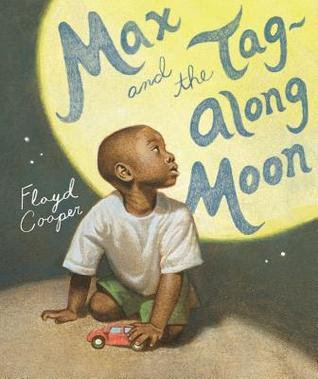
MAX AND THE TAG-ALONG MOON by Floyd Cooper and SHOW ME A SIGN by Ann Clare LeZotte


First we discussed our picture book, Max and the Tag-Along Moon written and illustrated by Floyd Cooper. We had a great read-aloud by one of our members, and those of us who had not held the actual book in our hands got an excellent 'feel' of the story and the wonderful illustrations. We all agreed that it was a lovely, child-centered story -- honing into what the little boy, Max, saw and felt as he remembered his "Granpa's" words that "...the moon will always shine for you." When dark clouds threatened on the way home, and obliterated the moon for Max, and when he was tucked into bed and still didn't see it, we felt that was a good moment of tension, and were pleased, as Max was, when the moon finally appeared and lit up his darkened room, fondly reminding him of and again connecting him with his Granpa.  We learned a bit about Cooper's art tecnique, which was to create a painting, and then 'erase' everything that was unnecessary. We loved how his technique created shading and an ethereal feeling to the illustrations. We all loved the depiction of the strong, special relationship between Max and his Granpa, and felt that pre-school kids especially would relate. We all agreed that it was a wonderful book, with a universal, though very simple and old-fashioned-feeling story. It was definitely a 'two thumps up.'


We all learned a lot from our novel, Show Me a Sign by Ann Clare LeZotte. We liked that it was told from the point-of-view of a deaf young girl, Mary, who let us know at the beginning that the language might seem different from what we were used to reading. We liked the historical aspects related to the deaf colony that had settled on Chilmark Island, part of Martha's Vineyard, south of Boston. We appreciated the descriptions of life there in 1805 -- which -- although quite insular -- was more than adequate to the island's dwellers, who had and did almost everything they needed, while using their own unique sign language, MVSL, long before the conception of ASL. We felt that some of the didactic-seeming passages that explained the plight of the deaf community were acceptable, since they helped us to understand Mary and the other deaf members of her village and to experience their world. We thought that when Mary was kidnapped and taken to Boston as the object of an experiment, it provided some action and suspense, and it made us keep reading to find out what would happen. We thought her descriptions of the stormy boat excursions to and from Boston were very real and harrowing. We realized very clearly, that deaf people were seen as less than human at that time in history, and were often poorly treated. We also liked the inclusion of many other issues: taking the Wampanoag Indians' land, the townspeople's relations with a previously enslaved Black man, the varying points of view of the citizens, the relationship between Mary and her friends, and her feeling of guilt over the death of her brother, whom she had lured out to a road where he was killed by a speeding horse carriage. We found the Author's Notes at the back especially helpful, giving us more specific information about Martha's Vineyard, Deafness there, the Wampanoag, Deaf Education, and the creation of ASL. We felt that young readers could relate to many aspects of the story, and -- as we did -- could learn a lot, and perhaps become more empathetic to people different from themselves. It was a good and worthwhile read.


Thursday, January 20, 2022

THE GREAT SHELBY HOLMES by Elizabeth Eulberg and WHEN ANGELS SING: THE STORY OF ROCK LEGEND CARLOS SANTANA by Michael Mahin


First, Big Congratulations to one of our Book Group members, Colleen Paeff, whose first book, The Great Stink: How Joseph Bazalgette Solved London's Poop Pollution Problem (Margaret K. McElderry, 2021) just received a Robert F. Sibert Informational Book Honor from ALSC, a division of the American Library Association. Here's a complete list of all of the awardees and honorees:
https://ala.unikron.comYMA%202022%20Wrap%20Release%20FINAL_01212022.pdf

We had a great discussion at our last meeting and were mostly positive about both of our books. We began with our novel, The Great Shelby Holmes by Elizabeth Eulberg. We mostly liked the characters and the story, and thought it was quite clever, well-written, and excellently plotted. We agreed that it could have been a bit shorter...some readers got tired of all of the time spent being 'inside' of John Watson's head as he described meeting, getting to know, and finally being accepted as a friend of Shelby, a young female neighborhood super-sleuth a la Sherlock Holmes, while trying to solve the mystery of a missing dog, owned by a very rich family. It was Shelby who decided to just call John 'Watson' since there were several other 'Johns' that she knew. We liked the way the two of them and the other young folks in the story acted like real kids; the way they navigated living in New York without helicopter parents; and the realistic portrayal of a New York neighborhood with its shops and local characters. We felt it was great that Watson was the one telling the story, and that the Shelby/Watson relationship was quite similar to that in the actual Sherlock Holmes stories by A.C. Doyle. (The author is a fan.) There was some question as to why the author and illustrator chose to make Shelby white, while Watson and the rich family were black, since some of the actions and situations just didn't make sense, and nothing regarding their races was ever mentioned -- only shown in the illustrations. One reader felt it was a 'cute story,' but she didn't 'buy' the fact that Watson's mom, a black woman, was an Afghanistan veteran who now worked at Columbia University, as well as a few other plot points, such as no explanation of why Watson's parents were separated, even though Watson's dad was constantly in his thoughts. We particularly liked the way the writer kept the mystery going, and a few of us really wanted to know 'whodunit' -- the answer to which we finally got, very near the end of the book -- after several very well-plotted misdirections. We all felt that kids in the intended readers' age group would enjoy the story, and it would be a great introduction into reading mysteries.

We all loved our picture book, When Angels Sing: The Story of Rock Legend Carlos Santana by Michael Mahin; illustrated by Jose Ramirez. We agreed that the colorful, vibrant illustrations were marvelous, and we loved the musical poetry of the text. We felt that by using the second person, "When you were born..." the writer puts us directly into Carlos' head as he tries to figure out his place in the world of music -- listening, trying out different instruments, feeling that music makes angels real, and trying to find his own angels as he continues to grow and improve his musical skill. We see his creativity flourish as he internalizes different genres of music and is also aware of the problematic world around him in the late 1960s and his wish to use music as a uniter between people comes to a guitar-riffing, cymbal-clashing climax at Woodstock in 1969, where the 400,000 music fans in attendance cheer for his multicultural band. A link to that performance is here: https://www.youtube.com/watch?v=nPauXWjY4T8  We felt that young readers who are interested in music would enjoy this short picture book biography, and might be interested in further exploring the resources that are mentioned in the Back Matter of the book.