WELCOME

WELCOME! For the last 19 years, about once a month, usually on a Thursday evening, a group of writers, illustrators, teachers and librarians meets in the Los Feliz area of Los Angeles to discuss children's books. Lately we have started meeting at lunch time, once every three months. Usually we talk about one picture book and one middle grade or YA novel. After the meeting, Sandy Schuckett, a retired LAUSD librarian, summarizes our discussion. Here are her reports of our thoughts about the books we have read. We'd love to have your comments too!
Thanks to Nancy Hayashi for our wonderful title art! NOTE: We are changing to a new schedule. Our meetings will now be quarterly and during the afternoon. Our group has been meeting since 2007. It was organized under the auspices of the Children's Literature Council of Southern California (CLCSC).

Thursday, September 8, 2022

CHESTER VAN CHIME WHO FORGOT HOW TO RHYME by Avery Monsen and THEY WENT LEFT by Monica Hesse


We began our discussion with our picture book, Chester Van Chime Who Forgot How to Rhyme by Avery Monsen, illustrated by Abby Hanlon. We all agreed that it probably wasn't the greatest picture book of all time, but it would be very useful in classroom or home situations as a read-aloud to reinforce vocabulary development in young (PreK-2/3) children. Although essentially written in rhyme, the final rhyming word is replaced each time by its meaning...well -- because Chester forgot how to rhyme. But the illustrations must be perused carefully -- because the REAL rhyming word is incorporated into many of the pictures. We felt that teachers and students could have fun with this book, and that it would be great for encouraging close observation of the colorful, humorous, and delightfully detailed illustrations. It presents many, many rhyming pairs throughout the story and on the front and back endpapers, and it could be used to create an opportunity for children to come up with their own rhymes. Near the end Chester figures out that playing with wby words should be FUN, which is a good seed to plant in the minds of small learners.


Our very meaningful novel, They Went Left by Monica Hesse impressed us all by its page-turning, authentic, and unfortunately rarely-told story of young people who survived the Holocaust, and their lives after they were released from the concentration camps during World War II. The protagonist, Zofia starts out a broken person, whose only mission upon her release is to find her missing younger brother, Abek. Although there were many characters to remember, we all thought the story unfolded in a believable manner, superimposing Zofia's memories of life in the camp with what she was experiencing at the moment. We agreed that it presented a gripping example of the thoughts and feelings of a young person recovering from the trauma of losing loved ones, seeing various horrors, seemingly falling in love, which is then betrayed, and using her talent and skill in sewing to help her return to reality AND solve a big mystery. Readers were riveted and haunted by this story, which made many feel that maybe their current 'problems/inconveniences' weren't so bad after all. We felt that the Author's Note at the end did a good job of explaining Hesse's research and her point of view which was to create a combination of sadness and hope, which this novel certainly did...ending with Zofia's wish for 'going home' with her new 'brother' Abek to create a new life across the ocean. We all agreed that YA readers would like this engrossing, emotional, realistic rendering of a very human story of such historical importance.

Thursday, August 4, 2022

SOUL FOOD SUNDAY by Winsome Bingham and WHEN YOU LOOK LIKE US by Pamela N. Harris


We began our discussion with our picture book, Soul Food Sunday by Winsome Bingham and Illustrated by C.G. Esperanza. We had various reactions to this book. Most of us loved the vibrantly colored, detailed illustrations of the young Black boy who decided to help his Granny in the kitchen as she prepared the delicious food for the weekly large family Sunday gathering at her house. A couple of readers were not so entranced by the art -- they weren't fans of Esperanza's somewhat bold and brash style. That's OK. Most of us liked the repetitive text where the little boy worked very hard as he learned various important tasks and was praised by his Granny each time with a repeated phrase. We were honored to have one 17-year-old join us, and she liked the book a lot because it helped her to learn about a custom and food of another culture. She said she would have liked to read it as a younger kid. One reader was not so thrilled with the book, she said it didn't seem real, and she had issues with some of the cooking details presented. We thought it could be useful in conjunction with several other excellent books about the foods and gatherings of different cultures.


We all agreed that our novel, When You Look Like Us by Pamela N. Harris was too long, and contained some scenes that could easily have been cut. We all felt for 16-year-old Jay whose dad had died, whose mother was in prison, and whose older sister Nic was missing, and we all had the need to keep reading just to see if she would be found. We got a glimpse into the good and bad parts of his life in the housing project where he lived, his school interactions, his friends, his love for his grandma (MiMi) and his desire to take charge of finding his sister, where several blunders were made. But -- many of us felt bothered by the fact that he didn't tell anyone Nic was missing for the longest time, and that when he finally did it was almost too late. A couple of readers said it reminded them of a Nancy Drew mystery, others didn't see that. We were all glad about the ending, although most of us felt it was almost too 'pat' when his sister was found. One reader absolutely loved it, and felt that all of the characters and actions in the book were very real. Another mentioned that it was all about perceptions and expectations -- how Jay thought he was perceived by various adults, teachers, other kids in his life, the police -- and how the expectations he had of many of them turned out to be wrong. We all agreed that young middle- and high-school readers would love this book.


Tuesday, July 5, 2022

WATERCRESS by Andrea Wang, illustrated by Jason Chin, and THE LAST CUENTISTA by Donna Barba Higuera


It was interesting this month that both of our books spoke to the importance of story. We began with our picture book, Watercress, by Andrea Wang; illustrated by Jason Chin. We all loved the "breathtakingly beautiful" poetic writing and the perfectly executed illustrations, using Chinese art techniques and brushes, of this first-person story of a young girl whose parents are immigrants from China. She describes the annoyance she feels when her parents stop the car on a family trip to pick watercress growing by the side of the road, and then her refusal to eat it later because it reminds her of "hand-me-down clothes and roadside trash-heap furniture." The importance of story comes to the fore when her mother shows an old family picture, showing famine years ago in China, and ultimately our heroine comes to the realization that her mother's younger brother had died because of it, and her outlook on everything changes. We loved the way it depicted an example of the immigrant experience, of struggling, of yearning for a land long ago left, and of a young girl being ashamed because she isn't "American enough." We felt that it was an excellent read-aloud that students with immigrant parents could relate to, and that would give non-immigrant kids an understanding of what it felt like to be different. We also related to the universal shame of being economically needy, and wanting to be able to just buy things at the store rather than obtain them by other means. We also thought that it would encourage all readers (and listeners) -- especially youngsters -- to seek out and hear and ultimately tell -- the stories of their own families.


Stories were also the emphasis in The Last Cuentista by Donna Barba Higuera; the title of which actually means 'the last storyteller.' We had a variety of reactions to this dystopian novel, which starts in the year 2061, when Earth is threatened with total destruction by a giant comet, and goes on for seemingly hundreds of years, as Petra a 13-year-old and her younger brother Javier and scientist parents are among those chosen to begin/create life on Sagan, a new planet. We all agreed that the book was too long, and the plot somewhat convoluted as we learned that everyone's memories of Earth had been technologically removed...everyone except Petra, who continued to remember her life on earth as well as her time spent with her beloved grandma (abuelita, or Lita) who made her very aware of her ancient culture thru the vehicle of storytelling. We liked the relationship Petra had had with her 'Lita' and her desire to not only remember her past on earth, but to share her stories with other children in her midst to help them remember their families also. There are so many more details to this story, too numerous to recount here -- which is mostly why it needed editing -- and why we had mixed feelings about the book. One reader absolutely loved it, and said it brought her to tears when Petra's brother was found and made the ultimate sacrifice so that all could live, and she felt that middle schoolers today would "eat it up" given the kinds of stories they are 'into' these day about alternate universes -- online and in books and movies. Although the rest of us all found parts that we liked, we were mostly not fans of dystopian fiction. A couple of readers felt that some of the things that happened to many of the characters were just 'too horrible', and one reader felt that most of the tropes of this sci-fi fantasy had been done before -- that there was nothing new here. Others had a hard time getting thru the whole book (but did!) and felt that there were just too many details to remember and that it wasn't particularly engaging. Our bottom-line conclusion was that there will be plenty of young readers (and -- obviously adults -- since it is a Newbery Award winner) who will love it, and others, like those in our group, for whom it just isn't their 'cup of tea.'

Thursday, May 26, 2022

CUBA IN MY POCKET by Adrianna Cuevas and EYES THAT KISS IN THE CORNERS by Joanna Ho and illustrated by Dung Ho


We began with our novel, Cuba in my Pocket by Adrianna Cuevas. We all liked the sensory picture that twelve-year-old Cumba painted of his native Cuba and his loving family and friends -- we could see, hear, feel, smell all that he described of the life he loved but had to leave in 1961 after the Revolution. We also liked his first-hand description of his experiences as a new immigrant in the U.S. -- getting used to a new language, food, people, activities, school, and missing his quite affluent family and his country. We felt that many young readers, immigrants themselves, could relate to this and that non-immigrant kids could get a feel for what some of their fellow-students might be experiencing -- perhaps creating some empathy. We also liked Cumba's voice, and were gripped by his feelings as he had to leave the home he had known in order to avoid being conscripted into the military, and we thought that the tension in the story was well-maintained throughout. We understood the author's need to fictionalize the story of her own father's journey from Cuba to the U.S. in 1961 and were thankful for her note at the end of the story as well as the Glossary of many Cuban terms. However, a couple of readers had mixed feelings about this book, since they were fans of the Revolution, and what it had accomplished for the millions of mostly poor, mostly black, and mostly illiterate Cuban peasants, namely: a 98% literacy rate due to the Literacy Brigade; free education for all; and free health care in every neighborhood. It was noted that the very poor peasants did not have the opportunities that Cumba had, due to his professional parents' knowledge, connections, and wealth. All of that considered, we were all happy that -- in the story -- Cumba's family was ultimately able to join him in Florida in the end. We felt that this could be a very useful book for middle-schoolers to further their knowledge about immigration, trying to 'fit in', and the universal 12-year-old angst that many young folks experience.


We all agreed that the biggest strength of our picture book, Eyes that Kiss in the Corners by Joanna Ho and illustrated by Dung Ho was the group of vibrantly colorful, detailed, and in some places quite fanciful digitally created illustrations that we felt really served to tell the story in the voice of a little girl who compares her eyes with those of her mom, grandma, and little sister. We liked the inclusion of the folkloric/mythic images from the stories her grandma told, and the warm connection between three generations of females. We felt that much of the text was glowing and poetic, but that other parts were a bit overwritten. We had a hard time determining exactly where this story took place, and would have been very thankful to have been able to read an Author's Note with further details. We loved the fact that the story (and the title) placed value on something that has been de-valued -- the eyes of people with Asian ancestry -- and the fact that this very short picture book served to define their beauty. We thought it could be a great read-aloud, and gave it a 'thumbs-up'!

Thursday, April 28, 2022

DOUBLE BASS BLUES by Andrea J. Loney and WHEN WINTER ROBESON CAME by Brenda Woods


We began our April discussion with our picture book, Double Bass Blues, by Andrea J. Loney; illustrated by Rudy Gutierrez. We unanimously loved the vibrantly colored, action-packed, and symbolic illustrations -- including the front and back endpapers -- in this book, which were mostly the vehicle for telling the story. Double-bass player Little Nic -- after being hailed as a star in his school orchestra -- has to lug his clumsy, heavy bass on a bus from school to his granddaddy's house. The many details in the illustrations tell the story and also cause readers to be very observant. On the way, Nic's many experiences are shown by various painted sound words, some of which are made by his clunky bass, some by nature, and some by taunts from others he encounters. A couple of readers felt that these words got in the way; others liked them. We wondered how much communication (if any) there had been between the author and the illustrator. We felt it was a unique book for young readers and liked the way that it represented jazz, especially at the end where Little Nic arrives at his granddaddy's place and is warmly greeted by 'real' jazz musicians who loudly applaud his playing. We liked the way the book dealt with his relationship with his grandpa, with showing his own talent, and with how he handled the bullying from some people he encountered on his journey. We felt that kids who are 'into' music would love this book, and we felt it could be used as a read-aloud in many K-12 school situations -- especially where music and art are emphasized.

We had various reactions to our novel, When Winter Robeson Came by Brenda Woods. A couple of readers were not big fans of novels in verse; they felt it was distracting by creating unnecessary (poetic?) pauses in their reading. Others were not bothered by that and said they had just read it like any other story. We all liked the historical perspective of the story told in the voice of 12-year-old Eden -- a budding musician/composer -- which was set in Los Angeles in 1965, "not too far from Watts". Some were a bit put off by some of the musical terms Eden added throughout her narrative, and said it felt like those words were just 'tacked on'. Eden welcomes her 14-year-old cousin Winter who has come from Mississippi to visit for two weeks. We liked the comparisons the two made between life in each place at that time. We also liked the way they navigated the city, using a telephone book (!) and maps and traveling by bus on various sightseeing trips, including to Watts Towers and the beach. A mystery element was introduced when Winter expressed that he was actually looking for his dad, who had come to LA ten years earlier and had seemingly disappeared. We liked the way that these two brave young folks became detectives, questioning significant people and following clues to find the dad (no spoilers here). We liked the relationship between Eden and her family and friends, and felt that all of the kids' voices and personality quirks were very real, and we also appreciated the vivid descriptions of the clothes, music, cars, buildings, and events of that time and place, including everyone's reactions to the 1965 rebellion in Watts that erupted in the middle of Winter's visit -- but played a relatively small part in the overall story. We also liked the compassion that was shown between various characters in times of stress or anxiety...and commented about how, sadly, these days it seems that a lot of that has been lost. We felt the book was quite accessible for young readers, and that they would enjoy a smooth read and learn something about how things were way before their time. We agreed this book could be a jumping-off point for further research.

Thursday, March 31, 2022

THE PAPER KINGDOM by Helen Ku Rhee and ARISTOTLE AND DANTE DISCOVER THE SECRETS OF THE UNIVERSE by Benjamin Alire Saenz


We began with our picture book, The Paper Kingdom by Helena Ku Rhee, illustrated by Pascal Campion. We all loved the light and glow of the illustrations as they depicted a little boy's reactions as his parents -- nighttime building custodians -- took him to work with them to a big skyscraper when their babysitter had to cancel. We liked the way his parents made up a story of a "paper kingdom" -- complete with dragons -- to explain the work they were doing, and to give him a chance to use his imagination though he might be in an uncomfortable circumstance. We liked the strength of the family being shown together, at home in their tiny studio apartment and at work, and the fact that they tried to portray their work as being "fun" for his benefit. We were a bit disappointed in the text, and felt it was a bit flat, plus we couldn't really see what advantage the so-called "dragons" added. We also felt the ending was a bit abrupt, and killed the flow of the story. We felt that this book filled a need for books about economic diversity, and that many young folks hearing this story could relate if their parents had similar work situations.


We all loved our novel, Aristotle and Dante Discover the Secrets of the Universe by Benjamin Alire Saenz. We loved the points of view of Ari and Dante in this character-driven story, with Ari as the narrator, but with Dante's ideas/feelings becoming evident via his conversations with Ari and his letters when he moved to Chicago. We felt it perfectly depicted the lives of boys of this age, with all of their angst, questioning, exploration, emotions, impulsivity, language, and humor. They were both so real, as were all of the complete and well-developed supporting characters and their personalities and actions. We loved that both Ari's and Dante's parents were sensitive, educated, concerned, well-meaning people -- even though they dealt with their sons in completely different ways, and both boys felt supported and loved -- a situation sometimes missing in many YA novels. We felt that the writing was superb: the poetry of it; the pacing; the flow; the thought-provoking ends of chapters. We felt that though it depicted young Mexican-Americans, this novel had a universal theme of teen-aged boys longing for someone who understands them while trying to figure out their own identities, be they ethnic, familial, sexual, intellectual, or ability-related. We felt it was a wonderful story of friendship and love, and we unanimously gave it a three(!!) thumbs-up.

Thursday, February 24, 2022

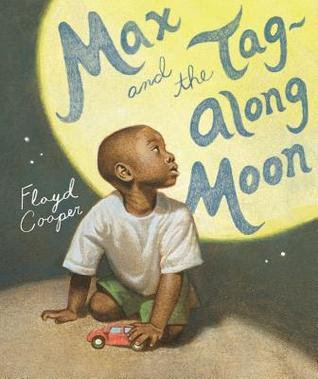
MAX AND THE TAG-ALONG MOON by Floyd Cooper and SHOW ME A SIGN by Ann Clare LeZotte


First we discussed our picture book, Max and the Tag-Along Moon written and illustrated by Floyd Cooper. We had a great read-aloud by one of our members, and those of us who had not held the actual book in our hands got an excellent 'feel' of the story and the wonderful illustrations. We all agreed that it was a lovely, child-centered story -- honing into what the little boy, Max, saw and felt as he remembered his "Granpa's" words that "...the moon will always shine for you." When dark clouds threatened on the way home, and obliterated the moon for Max, and when he was tucked into bed and still didn't see it, we felt that was a good moment of tension, and were pleased, as Max was, when the moon finally appeared and lit up his darkened room, fondly reminding him of and again connecting him with his Granpa.  We learned a bit about Cooper's art tecnique, which was to create a painting, and then 'erase' everything that was unnecessary. We loved how his technique created shading and an ethereal feeling to the illustrations. We all loved the depiction of the strong, special relationship between Max and his Granpa, and felt that pre-school kids especially would relate. We all agreed that it was a wonderful book, with a universal, though very simple and old-fashioned-feeling story. It was definitely a 'two thumps up.'


We all learned a lot from our novel, Show Me a Sign by Ann Clare LeZotte. We liked that it was told from the point-of-view of a deaf young girl, Mary, who let us know at the beginning that the language might seem different from what we were used to reading. We liked the historical aspects related to the deaf colony that had settled on Chilmark Island, part of Martha's Vineyard, south of Boston. We appreciated the descriptions of life there in 1805 -- which -- although quite insular -- was more than adequate to the island's dwellers, who had and did almost everything they needed, while using their own unique sign language, MVSL, long before the conception of ASL. We felt that some of the didactic-seeming passages that explained the plight of the deaf community were acceptable, since they helped us to understand Mary and the other deaf members of her village and to experience their world. We thought that when Mary was kidnapped and taken to Boston as the object of an experiment, it provided some action and suspense, and it made us keep reading to find out what would happen. We thought her descriptions of the stormy boat excursions to and from Boston were very real and harrowing. We realized very clearly, that deaf people were seen as less than human at that time in history, and were often poorly treated. We also liked the inclusion of many other issues: taking the Wampanoag Indians' land, the townspeople's relations with a previously enslaved Black man, the varying points of view of the citizens, the relationship between Mary and her friends, and her feeling of guilt over the death of her brother, whom she had lured out to a road where he was killed by a speeding horse carriage. We found the Author's Notes at the back especially helpful, giving us more specific information about Martha's Vineyard, Deafness there, the Wampanoag, Deaf Education, and the creation of ASL. We felt that young readers could relate to many aspects of the story, and -- as we did -- could learn a lot, and perhaps become more empathetic to people different from themselves. It was a good and worthwhile read.