We had a small but engaged group for our July (and third)
Zoom meeting. It appears that we are all getting used to this way of
meeting, and learning new things each time about how it all works.
One of our members read aloud: Fearsome Giant, Fearless Child: A Worldwide Jack and the Beanstalk Story by Paul Fleischman (2019). It is an interweaving of archetypic characters and motifs of JandtB
from around the world. The book turned out to be a less-than-wonderful
read-aloud because the beautifully colored illustrations are such an
important part of the story, and must be viewed closely for best impact.
Each page contains a small (usually 4"x6") box with a scene that
illustrates the accompanying text, framed by wide 2-colored border art
containing the name of the country depicted and motifs of that country
as well as symbols related to that part of the story. Without being able
to see these beautiful illustrations closely and clearly it was
difficult for the listeners to really "get" the author's intent. We all
loved the concept and the weaving together of different cultures showing
the parallel developments of the story from each place. We also loved
the end papers of the book which presented a flat map of the world,
which pinpointed the locations from which the parts of this story
originated. And we loved the idea of the illustrations when we
were able to see close-ups of a few of them that were available online.
However, as for the story itself, we unanimously agreed that it might
not work well with young children if they were not completely aware of
the original JandtB story and its variations. We felt that
jumping around from place-to-place/story-to-story was somewhat
confusing. However, those of us in education felt that it would be very
helpful to use with kids after they had heard various iterations
of the story, and they could then compare the various elements depicted
from one place to another. We also thought the end paper maps would be
very helpful in discussing how fairy tales changed from one location to
another.
One member called our attention to a book The Table Where Rich People Sit
by Byrd Baylor (1998). It's the story of a young girl who is unhappy
about her family's lack of money as they sit around their old raggedy
kitchen table. But as they all talk together, she discovers that
actually they DO have many riches -- those provided by the natural world
around them. We felt that this is a good book for these times, when
there is a lot of "stuff" that we suddenly DON'T have, but there are
still plenty of wonderful things all around us that can bring us joy and
contentment.
WELCOME
WELCOME! For the last 19 years, about once a month, usually on a Thursday evening, a group of writers, illustrators, teachers and librarians meets in the Los Feliz area of Los Angeles to discuss children's books. Lately we have started meeting at lunch time, once every three months. Usually we talk about one picture book and one middle grade or YA novel. After the meeting, Sandy Schuckett, a retired LAUSD librarian, summarizes our discussion. Here are her reports of our thoughts about the books we have read. We'd love to have your comments too!
Thanks to Nancy Hayashi for our wonderful title art! NOTE: We are changing to a new schedule. Our meetings will now be quarterly and during the afternoon. Our group has been meeting since 2007. It was organized under the auspices of the Children's Literature Council of Southern California (CLCSC).
Thursday, July 9, 2020
Thursday, June 4, 2020
MARVELOUS CORNELIUS: HURRICANE KATRINA AND THE SPIRIT OF NEW ORLEANS by Phil Binder and WE ARE THE GARDENERS by Joanna Gaines
We had our second Zoom meeting on June 4 (the first for
me!!) and it went quite well. I think we are all learning how to deal
with this experience in the best way in our own homes....lighting,
placement of computer, how to show pictures, etc. I personally missed
the Good Food that usually accompanies our discussions, and look forward
to the time when we can continue -- IN PERSON -- again.
First, Michelle read Marvelous Cornelius: Hurricane Katrina and the Spirit of New Orleans by Phil Binder (2015), the story of a beloved sanitation worker in New Orleans before and after Hurricane Katrina. We loved the illustrations which we felt really gave us the feeling of New Orleans, and we also loved a lot of the lyrical language that described Cornelius, his work, and his city. We felt that the story had a folktale-like feeling..perhaps similar to 'John Henry' stories, and that it was well-done. THEN we read the author's note at the back, where we learned that Cornelius Washington was a real man, a diligent and beloved worker for the NOLA Department of Sanitation, BUT that many of the events told in the story did not actually happen, and were just included to make the story better. WHAT??? This note totally destroyed our good feelings about the book, and we felt that it could have been solved if the author had merely stated, at the very beginning, something like, "...based on life and work of Cornelius Washington" We also noted that even though 'Hurricane Katrina' is in the title of the book, only two pages are devoted to that horrific tragedy....which didn't seem exactly right. So -- we liked it, but with reservations.
Caroline read us the second book, We Are the Gardeners by Joanna Gaines (2019). We acknowledged the fact that Gaines and her husband Chip are hosts of a reality show on HGTV which deals with home decor, gardening, cooking, and other family endeavors. We liked many things about this book: the fact that the family worked together, the explanations of how they planned their garden, and the trials and tribulations of creating a large family garden, and never giving up. We liked many of the illustrations showing how the plants developed, and the explanations of the various elements that are needed for a successful garden to thrive. We were unhappy however, that there was no real explanation of the time element entailed in creating a garden -- from the first planting of the seeds to the ultimate joy of having actual vegetables to eat. We thought that could be misleading for kids (and families) who might want to try the same activity at their own homes. We also thought that the entire narrative was just too long, and would have benefited from some cuts. We weren't sure that young readers would keep reading all that was written. But -- a book with some good qualities...so -- OK!
So -- not a bad way to spend an hour online doing something we all love: reading children's books!
First, Michelle read Marvelous Cornelius: Hurricane Katrina and the Spirit of New Orleans by Phil Binder (2015), the story of a beloved sanitation worker in New Orleans before and after Hurricane Katrina. We loved the illustrations which we felt really gave us the feeling of New Orleans, and we also loved a lot of the lyrical language that described Cornelius, his work, and his city. We felt that the story had a folktale-like feeling..perhaps similar to 'John Henry' stories, and that it was well-done. THEN we read the author's note at the back, where we learned that Cornelius Washington was a real man, a diligent and beloved worker for the NOLA Department of Sanitation, BUT that many of the events told in the story did not actually happen, and were just included to make the story better. WHAT??? This note totally destroyed our good feelings about the book, and we felt that it could have been solved if the author had merely stated, at the very beginning, something like, "...based on life and work of Cornelius Washington" We also noted that even though 'Hurricane Katrina' is in the title of the book, only two pages are devoted to that horrific tragedy....which didn't seem exactly right. So -- we liked it, but with reservations.
Caroline read us the second book, We Are the Gardeners by Joanna Gaines (2019). We acknowledged the fact that Gaines and her husband Chip are hosts of a reality show on HGTV which deals with home decor, gardening, cooking, and other family endeavors. We liked many things about this book: the fact that the family worked together, the explanations of how they planned their garden, and the trials and tribulations of creating a large family garden, and never giving up. We liked many of the illustrations showing how the plants developed, and the explanations of the various elements that are needed for a successful garden to thrive. We were unhappy however, that there was no real explanation of the time element entailed in creating a garden -- from the first planting of the seeds to the ultimate joy of having actual vegetables to eat. We thought that could be misleading for kids (and families) who might want to try the same activity at their own homes. We also thought that the entire narrative was just too long, and would have benefited from some cuts. We weren't sure that young readers would keep reading all that was written. But -- a book with some good qualities...so -- OK!
So -- not a bad way to spend an hour online doing something we all love: reading children's books!
Thursday, May 7, 2020
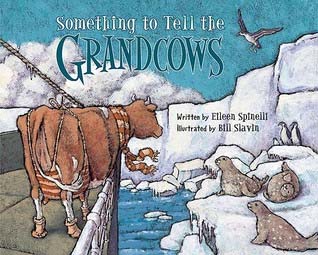
SOMETHING TO TELL THE GRANDCOWS by Eileen Spinelli and THE TWO BOBBIES: A True Story of Hurricane Katrina, Friendship and Survival by Kirby Larson and Mary Nethery
This month we had our first ever virtual meeting of Book Chat Thursday on Zoom. We had eight participants and a lively discussion. With libraries and book stores closed, we did not attempt to read books ahead of time. Instead, Ann Paul chose two books off her shelf and read them aloud, showing the illustrations via a second screen. The first was Something to Tell the Grandcows by Eileen Spinelli, illustrated by Bill Slavia, a fictional telling of a true event. We loved the way the cow conveyed her emotions and excitement of the adventure and at the same time was very cow-like. We also liked the inclusion of so much information about the trip and Antarctica–what they brought (suitcases, building material, even a ukelele) and what they saw (icebergs, seals, endless sunshine in summer and endless nights in winter.) We liked the language of the story and the illustrations that paralleled the light-heartedness of the text. Here’s a link to an article about the actual expedition: Cows in Antarctica
Our second book was The Two Bobbies: A True Story of Hurricane Katrina, Friendship and Survival by Kirby Larson and Mary Nethery, illustrated by Jean Cassels. This book tells the true story of a dog and a cat, both without tails, who got left behind during Hurricane Katrina and after fending for themselves for four months, finally found a friend at a construction site, and eventually a permanent home. We liked how the story depicted the friendship of the two animals and the way they helped one another. This book felt much more matter-of-fact than the first story. We discussed whether it would be shelved with fiction or nonfiction in the library. Some felt that it was fiction because no one knew exactly what happened to Bob and Bobby before they were rescued; others felt that as a true story, it should be classified as nonfiction. In any case, we felt that young children would enjoy hearing this story of friendship and learning more about the impact of Hurricane Katrina.
Thursday, March 26, 2020
THE RABBIT LISTENED by Cori Doerrfeld and WISHTREE by Katherine Applegate
Due to the corona virus, our meeting this month was cancelled. However, several of our members who had read the books shared the following comments.
The Rabbit Listened
Reader #1. I found the title intriguing, and the art charming – faces and bodies of both Taylor and the animals highly expressive. The choice to omit any background art was an effective way of keeping the focus on the characters. I particularly liked the fact that Taylor could be either a boy or a girl, so any child can identify. And the images of Taylor and the rabbit were sweet and tender. The message of the book was an essential one – sometimes just listening is the best choice – but ultimately the story came off as a little too message-y. Overall, though, I liked it.
Reader #2. I thought it would be a great read-aloud and I loved the illustrations -- the expressions on Taylor's and the animals' faces were wonderful, and I also liked all of the white space which eliminated distractions and allowed the reader to focus on what was actually shown. I thought it was so good that Taylor could be a boy or a girl...the illustration gave no clue or opinion on that. I also liked the parallel between all of the animals' suggestions and what Taylor ultimately told Rabbit, and I loved the fact that Rabbit listened -- a great message for young and old.
Wishtree
Reader #1. I wanted to like this book much more than I did. Katherine Applegate is a terrific writer, and she can be very imaginative. I loved Ivan. This novel had some strong moments and a certain dry, arboreal humor, but it took forever to get started, and once the story was launched, it was too sentimental for my taste, and too predictable. A kid, however, might be much more engaged than I was.
Reader #3. It took way too long to get into the story. I’d doubt that kids would be that patient. If I remember correctly it took nearly 30 pages before any kid came in. I nearly didn’t read further, but suffering from a mother’s admonition to “finish what you start,” plugged on and was sorry that I did. Too pat, too predictable, too preachy.
The Rabbit Listened
Reader #1. I found the title intriguing, and the art charming – faces and bodies of both Taylor and the animals highly expressive. The choice to omit any background art was an effective way of keeping the focus on the characters. I particularly liked the fact that Taylor could be either a boy or a girl, so any child can identify. And the images of Taylor and the rabbit were sweet and tender. The message of the book was an essential one – sometimes just listening is the best choice – but ultimately the story came off as a little too message-y. Overall, though, I liked it.
Reader #2. I thought it would be a great read-aloud and I loved the illustrations -- the expressions on Taylor's and the animals' faces were wonderful, and I also liked all of the white space which eliminated distractions and allowed the reader to focus on what was actually shown. I thought it was so good that Taylor could be a boy or a girl...the illustration gave no clue or opinion on that. I also liked the parallel between all of the animals' suggestions and what Taylor ultimately told Rabbit, and I loved the fact that Rabbit listened -- a great message for young and old.
Wishtree
Reader #1. I wanted to like this book much more than I did. Katherine Applegate is a terrific writer, and she can be very imaginative. I loved Ivan. This novel had some strong moments and a certain dry, arboreal humor, but it took forever to get started, and once the story was launched, it was too sentimental for my taste, and too predictable. A kid, however, might be much more engaged than I was.
Reader #3. It took way too long to get into the story. I’d doubt that kids would be that patient. If I remember correctly it took nearly 30 pages before any kid came in. I nearly didn’t read further, but suffering from a mother’s admonition to “finish what you start,” plugged on and was sorry that I did. Too pat, too predictable, too preachy.
Thursday, February 27, 2020
SAVING WINSLOW by Sharon Creech and THE UNDEFEATED by Kwame Alexander, illustrated by Kadir Nelson
We all agreed that the illustrations in The Undefeated, by Kwame Alexander and illustrated by Kadir Nelson, were gorgeous and astounding. We had mixed feelings regarding the text. Some felt that the marriage of the text and illustrations was perfect, while others felt that the text -- without the illustrations -- could not stand on its own. Many said that they liked how the book began, as it described, in poetic form, the trauma, passion, perseverance, and accomplishments throughout African-American history in the U.S., but some began to be a bit put off by the fact that the actual people mentioned later were athletes and music stars...where were the writers, scientists, political figures, philosophers, historians, etc. who had contributed so much to our culture? We felt that this was not a typical 'children's picture book,' and that it would be most useful for Grades 5 and above, as well as for adults, and we agreed that the 'Back Matter,' which identified in greater detail the historical figures and events depicted in either words or pictures throughout would be helpful for readers interested in doing further research to learn more.
Thursday, January 30, 2020
SKULLS by Blair Thornburgh and PATRON SAINTS OF NOTHING by Randy Ribay
We began our January discussion with our picture book, Skulls, by Blair Thornburgh and illustrated by Scott Campbell. We all liked the illustrations and the fact that this seemingly simple picture book raised the issue of how important our skulls are to our lives. We loved how the book began, but sadly, we felt that it became a bit boring, as certain facts were unnecessarily repeated. We tried to figure out why it was a 40-page picture book, which is unusual, and we felt that it would have worked better in the traditional 32-page format with some of the redundant parts eliminated. We liked the idea of introducing young children to this very important part of their bodies. There were a couple of page spreads that we really liked, and we liked the last page which included several facts about the skull. We thought it might work well in a school setting if combined with a more traditional nonfiction book about skulls with actual photos and more emphasis on facts. A couple of readers also felt that this could be a great book to use for 'Day of the Dead' celebrations, where images of skulls/skeletons play a big role.
We had mixed feelings on our novel, Patron Saints of Nothing by Randy Ribay. We all agreed that this story of high school senior, Jay, who travels from his home in Michigan to the Philippines to find out why his beloved cousin, Jun, was accused of being a drug dealer and killed by the government at a very young age provided a great glimpse into contemporary Filipino culture. Most of us didn't really relate to Jay, and we had minimal feelings for him, even throughout his trials and tribulations. We felt that the book was more plot-driven than character-driven. One reader felt that the whole reason for this book was to expose the current situation in the Philippines. Another reader said that she just didn't like Jay at all -- he was a self-centered, cell-phone-driven obnoxious teen-aged boy -- but she thought that the information about the current culture in the Philippines and the havoc that its despotic ruler is wreaking on its citizens was important for young readers to know. We felt that high- schoolers might like this book since they could relate with much of the angst in the story.
Thursday, December 12, 2019
Holiday Dinner Meeting
![]() |
| Holiday potluck of Book Chat Thursday |
Subscribe to:
Posts (Atom)