We started with our picture book School's First Day of School by Adam Rex (2016). We all had generally positive feelings about this book. We all loved the voice of the newly built Frederick Douglass Elementary School, who was trying to figure out why he was even there. His morning and afternoon conversations with Janitor, helped him to figure out what a 'school' was and what he was supposed to be and do. We liked how his 'personality' evolved, as students arrived and went through their first day, where he also learned a few things, played a couple of tricks on the students -- a fire drill and a water squirt -- and felt empathy for a little freckled girl who didn't even want to be there -- but by the end of the day changed her mind. One reader felt that the beginning and ending were somewhat 'flat' but she liked the middle and main part of the story. A couple of other readers felt that the ending was quite abrupt and unsatisfying. We all liked the illustrations showing a multicultural group of children a lot, and one reader pointed out that reading the book and looking carefully at the illustrations several times made her notice new details in the pictures each time. All things considered, we all basically liked the book and felt it would be a great read-aloud for a new kindergarten class on the first day of school, and could help children to compare their own feelings with those of 'the school' as well as the students in the story.
WELCOME
Thanks to Nancy Hayashi for our wonderful title art! NOTE: We are changing to a new schedule. Our meetings will now be quarterly and during the afternoon. Our group has been meeting since 2007. It was organized under the auspices of the Children's Literature Council of Southern California (CLCSC).
Thursday, November 12, 2020
SCHOOL'S FIRST DAY OF SCHOOL by Adam Rex and INSIGNIFICANT EVENTS IN THE LIFE OF A CACTUS by Dusti Bowling
We started with our picture book School's First Day of School by Adam Rex (2016). We all had generally positive feelings about this book. We all loved the voice of the newly built Frederick Douglass Elementary School, who was trying to figure out why he was even there. His morning and afternoon conversations with Janitor, helped him to figure out what a 'school' was and what he was supposed to be and do. We liked how his 'personality' evolved, as students arrived and went through their first day, where he also learned a few things, played a couple of tricks on the students -- a fire drill and a water squirt -- and felt empathy for a little freckled girl who didn't even want to be there -- but by the end of the day changed her mind. One reader felt that the beginning and ending were somewhat 'flat' but she liked the middle and main part of the story. A couple of other readers felt that the ending was quite abrupt and unsatisfying. We all liked the illustrations showing a multicultural group of children a lot, and one reader pointed out that reading the book and looking carefully at the illustrations several times made her notice new details in the pictures each time. All things considered, we all basically liked the book and felt it would be a great read-aloud for a new kindergarten class on the first day of school, and could help children to compare their own feelings with those of 'the school' as well as the students in the story.
Thursday, October 15, 2020
TODOS IGUALES/ALL EQUAL--A Ballad of Lemon Grove by Christy Hale and SCARY STORIES FOR YOUNG FOXES by Christian McKay Heidicker
We began our October discussion with Todos Iguales/All Equal -- A Ballad of Lemon Grove by Christy Hale (2019), the story of the first successful school desegregation case in the United States in Lemon Grove, CA in 1921. We all agreed that this narrative of Roberto Alvarez -- an excellent student -- who, along with his other Mexican-American schoolmates was denied access to the local public school, and sent instead to an "equal" (but actually quite inferior) school for Mexican students, was an important story that had to be told. We felt that it was a good companion to a book about a similar case in 1947, involving Sylvia Mendez in Westminster, CA, Separate is Never Equal by Duncan Tonatiuh. We loved the illustrations which were brightly painted and reminiscent of the labels on the wooden crates of citrus fruits that were used in the 1920s-1940s. We also liked the pictures of the various children, and especially liked the several pages of 'Back Matter,' which presented photos of the actual people involved, more details about the case, the school board, the judge, the decision, maps, quotes, etc. What we felt was missing from this book was emotion...it was told in alternating sections of English and Spanish in a very straight-forward journalistic manner, and attempted to include too many details, while neglecting any real evidence of the feelings of the children (and their parents) involved in the lawsuit, which they finally won. We were also a bit confused by the fact that the book was based on a Corrido -- a traditional Mexican-style ballad about a historical event -- the music and lyrics of which were produced in their entirety on the first two pages, but never mentioned again. We wished that the text of this important book had been wonderful and compelling, but we were still happy that it had been created, and we felt it had an important place in classrooms, both in 3rd-5th grade, and even in middle or high school when the issue of school desegregation was a topic of discussion as a part of the Social Studies curriculum.
Thursday, September 10, 2020
BROWN ANGELS by Walter Dean Myers and THE VANDERBEEKERS OF 141st STREET by Karina Yan Glaser
We had mixed feelings about our novel, The Vanderbeekers of 141st Street (2017) by Karina Yan Glaser. We all agreed that it was a very 'old-fashioned' book, reminiscent of The All-of-a-Kind Family or Little House on the Prairie, and that factor was a plus for some readers and a minus for others. A couple of us loved this story of a family of Mom and Dad and five children: Jessie and Isa,12-year-old twin girls; Oliver, 9; Hyacinth, 6; and Laney, 4 3/4. The family was losing their lease of their dad's childhood brownstone home in Harlem (NYC) by their seemingly grouchy landlord, Mr. Beiderman, who was feared by all. As the children tried various plans to circumvent this dire situation, five days before Christmas, they became individuals -- each with their own quirks -- and there were several plot twists that brought out each of their personalities as well as those of their parents. Everyone agreed that once they 'got into' the actual story there was suspense, and even though we knew the family would probably be able to stay in their house at the end, there were several surprises before that was actually assured. But some readers felt that the language was just too old-fashioned, and that even though the story takes place sometime after 2007, it just wouldn't grab the interest of today's kids in the 9-13-year-old reading crowd. Some felt that there was a disconnect between the language of the narrative and the way kids actually talked during the time of the story. We basically agreed that it was definitely a very 'wholesome' story and that it was great that the children were given space to figure things out and to solve their problems without hovering parents. Another issue was the fact that this seemed to be an interracial family, but that was never really clearly dealt with, which seemed unrealistic, given the time and the place. Some readers felt that this story could have taken place anywhere; and even though it was in Harlem, in New York, they really didn't get a feeling of that from the story. We learned that this book is the first in a series, and that three sequels follow. Some will read them; some will not. This discussion was a great example of why the differences in opinions and reactions to books makes our group so interesting and fun!
Thursday, August 6, 2020
BIG PAPA AND THE TIME MACHINE by Daniel Bernstrom and THE OLD TRUCK by Jarrett and Jerome Pumphrey
But the books were quite different. 'Big Papa's' strength was shown in the title character -- a grandfather -- who, while driving around Chicago with his grandson who was afraid of starting school, recounted various events in his life, and emphasized that every time he was scared, he also realized that he was brave. Their magical car went back to Arkansas, 1952; Chicago, 1955 & '57; Chicago, 1986; and Arkansas, 1941. In each instance, Big Papa recounted his fear, and how what he had learned had made him brave.The lyrical writing and the conversation between the two of them was a pleasure to listen to aloud. The emphasis on learning from life and in school were evident throughout. We all agreed that the strength of this story was in the language, but we also liked how the 'historical' parts were shown in dreamlike/foggy/pastel colors, while the 'today' parts were in bright colors. We all felt the book was a 'hit'!
Thursday, July 9, 2020
FEARSOME GIANT, FEARLESS CHILD by Paul Fleischman and THE TABLE WHERE RICH PEOPLE SIT by Byrd Baylor
One of our members read aloud: Fearsome Giant, Fearless Child: A Worldwide Jack and the Beanstalk Story by Paul Fleischman (2019). It is an interweaving of archetypic characters and motifs of JandtB from around the world. The book turned out to be a less-than-wonderful read-aloud because the beautifully colored illustrations are such an important part of the story, and must be viewed closely for best impact. Each page contains a small (usually 4"x6") box with a scene that illustrates the accompanying text, framed by wide 2-colored border art containing the name of the country depicted and motifs of that country as well as symbols related to that part of the story. Without being able to see these beautiful illustrations closely and clearly it was difficult for the listeners to really "get" the author's intent. We all loved the concept and the weaving together of different cultures showing the parallel developments of the story from each place. We also loved the end papers of the book which presented a flat map of the world, which pinpointed the locations from which the parts of this story originated. And we loved the idea of the illustrations when we were able to see close-ups of a few of them that were available online. However, as for the story itself, we unanimously agreed that it might not work well with young children if they were not completely aware of the original JandtB story and its variations. We felt that jumping around from place-to-place/story-to-story was somewhat confusing. However, those of us in education felt that it would be very helpful to use with kids after they had heard various iterations of the story, and they could then compare the various elements depicted from one place to another. We also thought the end paper maps would be very helpful in discussing how fairy tales changed from one location to another.
One member called our attention to a book The Table Where Rich People Sit by Byrd Baylor (1998). It's the story of a young girl who is unhappy about her family's lack of money as they sit around their old raggedy kitchen table. But as they all talk together, she discovers that actually they DO have many riches -- those provided by the natural world around them. We felt that this is a good book for these times, when there is a lot of "stuff" that we suddenly DON'T have, but there are still plenty of wonderful things all around us that can bring us joy and contentment.
Thursday, June 4, 2020
MARVELOUS CORNELIUS: HURRICANE KATRINA AND THE SPIRIT OF NEW ORLEANS by Phil Binder and WE ARE THE GARDENERS by Joanna Gaines
First, Michelle read Marvelous Cornelius: Hurricane Katrina and the Spirit of New Orleans by Phil Binder (2015), the story of a beloved sanitation worker in New Orleans before and after Hurricane Katrina. We loved the illustrations which we felt really gave us the feeling of New Orleans, and we also loved a lot of the lyrical language that described Cornelius, his work, and his city. We felt that the story had a folktale-like feeling..perhaps similar to 'John Henry' stories, and that it was well-done. THEN we read the author's note at the back, where we learned that Cornelius Washington was a real man, a diligent and beloved worker for the NOLA Department of Sanitation, BUT that many of the events told in the story did not actually happen, and were just included to make the story better. WHAT??? This note totally destroyed our good feelings about the book, and we felt that it could have been solved if the author had merely stated, at the very beginning, something like, "...based on life and work of Cornelius Washington" We also noted that even though 'Hurricane Katrina' is in the title of the book, only two pages are devoted to that horrific tragedy....which didn't seem exactly right. So -- we liked it, but with reservations.
Caroline read us the second book, We Are the Gardeners by Joanna Gaines (2019). We acknowledged the fact that Gaines and her husband Chip are hosts of a reality show on HGTV which deals with home decor, gardening, cooking, and other family endeavors. We liked many things about this book: the fact that the family worked together, the explanations of how they planned their garden, and the trials and tribulations of creating a large family garden, and never giving up. We liked many of the illustrations showing how the plants developed, and the explanations of the various elements that are needed for a successful garden to thrive. We were unhappy however, that there was no real explanation of the time element entailed in creating a garden -- from the first planting of the seeds to the ultimate joy of having actual vegetables to eat. We thought that could be misleading for kids (and families) who might want to try the same activity at their own homes. We also thought that the entire narrative was just too long, and would have benefited from some cuts. We weren't sure that young readers would keep reading all that was written. But -- a book with some good qualities...so -- OK!
So -- not a bad way to spend an hour online doing something we all love: reading children's books!
Thursday, May 7, 2020
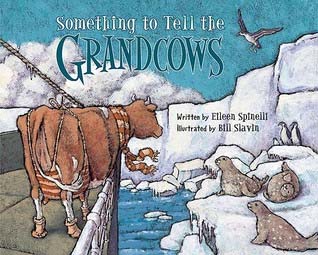
SOMETHING TO TELL THE GRANDCOWS by Eileen Spinelli and THE TWO BOBBIES: A True Story of Hurricane Katrina, Friendship and Survival by Kirby Larson and Mary Nethery
Our second book was The Two Bobbies: A True Story of Hurricane Katrina, Friendship and Survival by Kirby Larson and Mary Nethery, illustrated by Jean Cassels. This book tells the true story of a dog and a cat, both without tails, who got left behind during Hurricane Katrina and after fending for themselves for four months, finally found a friend at a construction site, and eventually a permanent home. We liked how the story depicted the friendship of the two animals and the way they helped one another. This book felt much more matter-of-fact than the first story. We discussed whether it would be shelved with fiction or nonfiction in the library. Some felt that it was fiction because no one knew exactly what happened to Bob and Bobby before they were rescued; others felt that as a true story, it should be classified as nonfiction. In any case, we felt that young children would enjoy hearing this story of friendship and learning more about the impact of Hurricane Katrina.