WELCOME

WELCOME! For the last 19 years, about once a month, usually on a Thursday evening, a group of writers, illustrators, teachers and librarians meets in the Los Feliz area of Los Angeles to discuss children's books. Lately we have started meeting at lunch time, once every three months. Usually we talk about one picture book and one middle grade or YA novel. After the meeting, Sandy Schuckett, a retired LAUSD librarian, summarizes our discussion. Here are her reports of our thoughts about the books we have read. We'd love to have your comments too!
Thanks to Nancy Hayashi for our wonderful title art! NOTE: We are changing to a new schedule. Our meetings will now be quarterly and during the afternoon. Our group has been meeting since 2007. It was organized under the auspices of the Children's Literature Council of Southern California (CLCSC).

Thursday, September 8, 2016

PRESIDENT SQUID by Aaron Reynolds and JEFFERSON'S SONS by Kimberly Baker Bradley

At our last meeting, we began with our picture book, President Squid by Aaron Reynolds. We weren't very thrilled with the story of this very 'Trumpish' pink squid who thought he had the five necessary characteristics of a president who could fix everything, but when he discovered that actually helping someone required work, he changed his mind about wanting to be president....(and then decided he wanted to be King of the World.) We liked the illustrations, which were very colorful and quite humorous, and felt that one use for the book would be as a read-aloud to kick off a class discussion of what it really takes to be a leader. We didn't love the ending....except that it was kind of 'Trumpish' also. We did feel that the book was quite apropos during these unusual political times in which we are currently living. We also wondered at the timing of its publication...how quickly had it gone through the publication process which usually takes as long as a year or more?

We had a good discussion of our novel, Jefferson's Sons: A Founding Father's Secret Children by Kimberly Baker Bradley. We thought it did a relatively good job of explaining the institution of slavery to young readers, although it left a lot of questions unanswered. Several of us were put off by the construction of the novel: jumping around between the points of view of Beverly and Madison (Maddy,) the young sons of Thomas Jefferson and his slave Sally Hemings, and their friend Peter, another young slave. We felt that confused the flow of the story. We also felt that it was amazing that there was no feeling of underlying anger on the part of these boys and their mother, as well as their friends, whose lives were completely under the control of the whims of Jefferson. We thought the author had done quite extensive research, but we still had some problems with the dialog, which in many cases sounded too modern, especially in the uses of terms like 'okay' and 'nope' which weren't yet even coined during the 1809-1827 time period of the book. One of our members had read the actual historical accounts (the only ones available) of this unusual 'family,' and found some inconsistencies with the story we were reading. We agreed that it was a very difficult topic to bring to the table for young readers, and wondered how it would have been treated by an African-American author rather than the white one who wrote it. And the final question still remained: How could the man who wrote the Declaration of Independence (which was quoted in the story) have so little real consideration for the feelings of these human beings who were in fact his own family?

On a related note, one of our members thought people might like to read this discussion of slavery as it is treated in childdren's books. Link here: http://www.motherjones.com/media/2016/08/diversity-childrens-books-slavery-twitter

Thursday, August 4, 2016

JACOB'S NEW DRESS by Sarah Hoffman and THE WAR THAT SAVED MY LIFE by Kimberly Brubaker Bradley

We discussed our picture book first: Jacob's New Dress by Sarah Hoffman. We almost unanimously gave it a "meh" review. Although we all agreed that a story of a little boy wanting to wear a dress to school was certainly timely, we felt that the story itself was pretty dull, as were the illustrations. One reader felt the illustrations by Chris Case were, "sweet, if undistinguished." One reader disagreed. She felt that the book dealt perfectly with the issue, including the reactions of Jacob's loving and supportive, though questioning, parents. One reader felt that the reactions of Jacob's teacher were not helpful at all, and was very offended by the Author's Note at the end of the story, where Bradley explained that it was based on experiences with her own son, whom she and her husband had called "our pink boy." This led to a discussion about labels, and the damage they can do. One member mentioned another title, Morris Micklewhite and the Tangerine Dress by Christine Baldacchino (2014), which she felt dealt with the same issue in a much better manner.

As for our novel, The War that Saved my Life by Kimberly Brubaker Bradley, we had one of those rare-for-us UNANIMOUS moments. We all loved it! We loved the story, the characters, the development of the different relationships between them, and the inclusion of World War II history as it affected children in London in 1940 who were relocated to places outside of the city as bombing by Germany threatened, as were Ada and her little brother Jamie. We loved the beginning and ending sentences of each chapter, which grabbed the reader, and kept her engaged. (We're an all-female group!!) We loved the inclusion of the relationship between Ada and the pony, 'Butter,' and how the horse gave this 'throw-away' child a reason for living and feeling and -- hope. We also thought that Ada and Susan Smith, another 'throwaway,' who had reluctantly taken in Ada and Jamie, each found something they needed in the other...even though it took a long time and many trials and tribulations before they could each admit it. We wanted Ada's miserable mother to be strung up by her fingernails for isolating Ada in an under-sink cabinet for nine years because she had been born with a club foot, and we loved how Ada's little brother Jamie was torn between wanting to go back to his mother and staying with Susan who actually loved him...a common reaction in abused children (and adults). There were many, many more things we loved about this book, but time and space constraints here prevent mentioning all of them. Because of the magnificence of this story, we decided to read another book by the same author for our next meeting.

Thursday, June 30, 2016

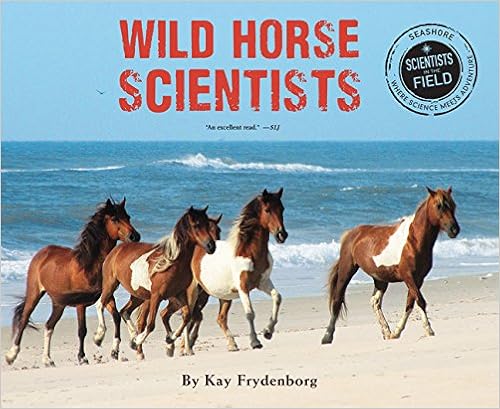
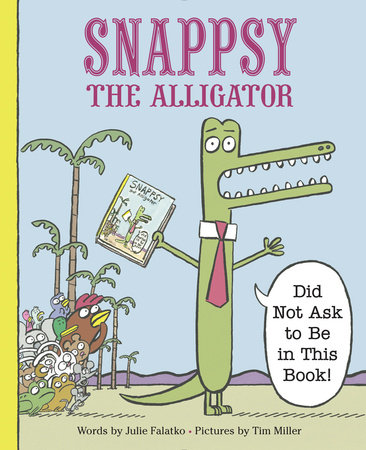
Wild Horse Scientists by Kay Frydenborg and Snappsy the Alligator by Julie Falatko

We  had terrific discussions at our last meeting, beginning with the nonfiction book, Wild Horse Scientists by Kay Frydenborg. One of our very creative members created a beautiful snack to go with the book. This same person, a died-in-the-wool long-time horse lover, said that of all the horse books she has ever read -- fiction, nonfiction, picture books, etc., this one was by far the best. We all agreed that it was quite wonderful, with beautiful photos and clearly written explanations of the detailed work of the various scientists who study the horses on Assateague Island. We felt it was an excellent example of how the scientific method works, and that it also presented a possible career path for students who were interested in horses. We felt it could be interesting for a wide range of readers -- from elementary through high school. 
Horse themed snack
We had a couple of minor carps: one was that all of the pages weren't numbered, making using the Index a bit cumbersome; another was that the sidebars -- some of which took up a few pages -- were distracting from the thread of the explanations. A couple of readers also thought it could have been better organized. We were all impressed with how the scientists figured out a way to use birth control shots for the mares so that the island wouldn't become overpopulated, given the resources that were available there. All things considered, it was a great read which presented information that none of us would have known otherwise...the sign of a good nonfiction book!

We were much less enthused with the picture book, Snappsy the Alligator by Julie Falatko. One reader stated that there was absolutely nothing about it that she liked -- not the story, not the pictures -- nothing. A few readers thought the illustrations were cute and quite humorous. One of our members said she read it with her grandchildren and they thought it was really funny and they loved it. But we adults generally felt that the premise of an author (in this case a chicken) inserting him/herself (hard to tell) into the story, and basically having a dialog with the main character (an alligator who didn't want to be in the story anyway, and felt completely misunderstood) was a very 'meta' concept, perhaps a bit too deep for young children to even understand. We talked a bit about how authors often say that "the character takes over the story" while they are writing, and we figured that perhaps this was what Julie Falatko was trying to show....but we felt that it pretty much fell flat, and definitely wouldn't be appealing to young children. Although many reviewers loved it, we didn't.

One of our members is also involved with a book group that discusses picture books by a particular publisher at each meeting. Some folks were interested in reading their blog, and it can be found here: pbpublishers101.blogspot.com. If you copy/paste it into your browser, it will be accessible.

Thursday, May 26, 2016

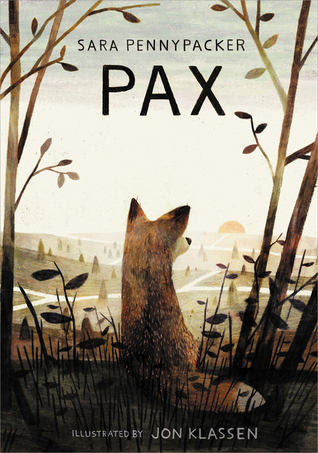
FOUND by Salina Yoon and PAX by Sara Pennypacker

We had quite animated discussions at our May meeting. We talked about the picture book, Found by Salina Yoon first. We all loved the illustrations and the simplicity of the story of a little tricycle-riding bear who finds a toy stuffed bunny in the forest, tries to find its owner, but then becomes very attached to the bunny, and ultimately has to return it to its original owner, a 'grown-up' necktie-wearing moose. We felt that it would be a good read-aloud, and might be helpful for kids who had to get rid of unused or outgrown toys. A couple of people loved the book, but a few others felt that it fell short in a few respects. They thought that the transition when the 'older' moose decided to give the bunny back to the little bear was a bit too 'convenient,' and that it would have worked better if there had been a couple of 'beats' between the moose reclaiming his bunny and then almost immediately returning it back to the little bear. But we basically liked it, and everyone loved the endpapers, which showed a colorful collage of various 'LOST' signs (and one 'FOUND' sign!), some of which would have garnered a good giggle from any adult reading this book to a little one.

We had several differing opinions on the novel, Pax by Sara Pennypacker, the story of 11-year-old Peter, who lived with his widower father, and had rescued a young orphaned fox from the forest, raised it as a pet, and then had to release it back to the wild when his father went to war and Peter was sent to live with his grandfather. The story is told in alternating chapters in the voices of Peter and the fox, as they are each determined to do whatever it takes to find the other, and as each has various harrowing adventures and adverse situations to overcome in the process. Many readers were upset and even a bit annoyed that there was no specific time or place for this story. Which war? Where? When? Others felt that didn't really matter since the major themes were related to letting go of something loved and then trying to find it again, and also to the idea of what really constitutes a family as well as the anti-war message provided in many of the passages that dealt with what war does to people (and animals.) Some readers felt that the author tried to undertake too much in the development of too many plot points, and others felt that both Peter and the fox seemed to exhibit just too much thought and insight given their ages and statuses (11 & a fox!) in life. Many felt that the character of Vola, an embittered female war veteran whose cabin Peter finds in the middle of a forest and ultimately befriends, was somewhat gratuitous, and really unnecessary; others thought she filled an important role in sort of substituting as a mother figure for Peter when he needed that. We all agreed that the black and white illustrations by Jon Klassen added absolutely nothing to the story, and we also all agreed that this book provided some beautifully written passages, and a lot of 'stuff' for us to think about, but none of us felt that it would become 'a beloved classic', as many of the reviews  had stated. ....and so it goes.

Thursday, April 28, 2016

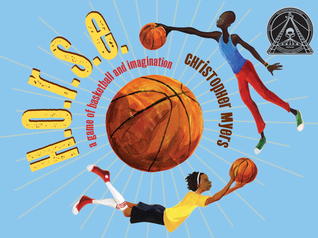
H.O.R.S.E. by Christopher Myers and THE HIRED GIRL by Laura Amy Schlitz

We had a small but vocal group at our last meeting. We discussed our picture book, H.O.R.S.E. by Christopher Myers first, and we all agreed that the illustrations were excellent: boldly showing the two main characters who are having the conversation, embellished with terrific collages of various New York buildings and scenes, and very well-designed, with the text appearing in arcs similar to the basketball shots they are describing. One of our members read the book aloud to us, and another said that she had absolutely NO interest in basketball, and -- in fact -- didn't read the book, but that hearing it read aloud gave her an appreciation of the language and the creativity the author/illustrator used as the two boys tried to outdo each other in their descriptions of the amazing shots they were prepared to accomplish in the game of H.O.R.S.E. We all basically liked it, although some a bit less than others, although all agreed that it was terrific for stimulating imagination and interesting use of language for young readers. We were amused that one illustration, describing a shot that transcended outer space before landing in the basket, included the illustration of an African-American man with a nametag reading, "NDGT," -- an homage to Neil deGrasse Tyson, the astrophysicist, author, and noted host of the TV program, Cosmos. We definitely felt that young readers would enjoy this book, and might even be drawn into describing their own astounding basketball shots with imagination and flowery language.

We all agreed that our novel, The Hired Girl by Laura Amy Schlitz, was beautifully written as it told the story of a 14-year-old girl from Pennsylvania who, in 1911 ran away from her family farm and an abusive father and arrived in Baltimore, where she lied about her age, changed her name, and was taken on as the "hired girl" for a prominent Jewish family. We all loved the beginning chapters and the ending chapters of this almost 300-page book, which was her actual diary in which she described her life. Several people felt that a lot of the descriptions of her daily life as she did the household work, dreamed about the clothes she would buy, and her relationships with the various family members could have been a bit shorter. One reader questioned the level of the writing in Janet/Joan's diary, saying that it seemed too sophisticated for a basically uneducated 14-year-old. Others felt it was completely believable, since she was an avid lover of reading, and had, in fact, run away from the farm when her father had burned her three cherished books, which she had read over and over and over again. Certainly, many of the entries in her diary compared her life with characters in the books she had read, and when the father of the household allowed her to read books in his library, her vocabulary and knowledge only grew. She was definitely a reader and a thinker. We agreed that young readers who might be daunted by such a long book might decide to 'give it a try,' once they found out that there was a love story between Janet/Joan and David, the family's youngest son, who dreamed of becoming an artist instead of carrying on as the proprietor of his father's department store. We all agreed that it was a pretty complicated plot, with a lot of details that perhaps didn't add much, but some thought that the inclusion of the detailed descriptions of Jewish holidays and other minutiae of daily life were valuable. But -- in the final analysis -- positive feelings all around.

Thursday, March 31, 2016

FINDING WINNIE: The True Story of the World's Most Famous Bear by Lindsay Mattick and A CROOKED KIND OF PERFECT by Linda Urban

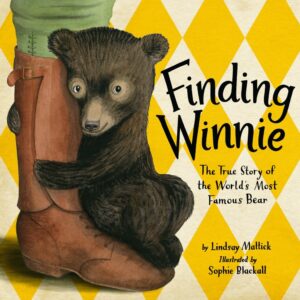
We began our last meeting with a discussion of the picture book, Finding Winnie by Lindsay Mattick and illustrated by Sophie Blackall. Although we all came prepared to say quite good things about this book, one of our members produced and then read aloud to us another book on the exact same subject/situation: Winnie: The True Story of the Bear who Inspired Winnie the Pooh, written & illustrated by Sally M. Walker. Wow! It ended up being a 'compare and contrast' discussion between these two terrific, but very different picture books which told the story of a real bear cub who was purchased for $20 in Canada, accompanied Harry Colebourn, a veterinarian for the Canadian army to a camp in Europe during World War I, and ended up in the London Zoo where she was discovered by Christopher Robin and his father A.A. Milne. We felt that the first book, presented as a story being told to Colebourn's toddler-looking great-great-grandson, Cole, was sweet in intention with some quite poetically written passages, but that the many interruptions where Cole's mom was actually telling him the story were annoying and broke the mood of the actual story of Winnie. In the second book the story was told in a matter-of-fact, well-written, linear style, and contained many more details about Harry and Winnie, and we felt it would be better understood by young readers or as a read-aloud. It also contained back matter that provided many more details, which the first book lacked. We liked the illustrations in both books for various reasons, although we felt that a couple by Blackall (in the first book) didn't maintain the same mood as some of her others did. We also liked the fact that both included a ' photo album' format: presenting actual photos of Harry, Winnie, the soldiers, C. Robin, and even Milne that gave complete credence to Winnie's story. Finally...we discussed the fact that when Winnie was in the London Zoo, children (including CR) were allowed to come into her cage and play with her!! This would obviously never happen today, and we talked about the concept of 'adopting' wild animals, and how this wasn't such a great idea for 'regular' people. A couple of people felt that there should have been a "don't try this at home" caveat. Verdict: two very different, but quite good books on an interesting subject.

We all liked the novel, A Crooked Kind of Perfect by Linda Urban. We felt that although the family in the story could have been perceived as dysfunctional, with an unemployed dad who didn't like to leave the house and was basically afraid of people, a workaholic mom, and the 11-year-old protagonist, Zoe, who pretty much had to fend for herself, the story was actually very positive as it showed how these three people loved, understood, and truly communicated with each other...although probably in quite nontraditional ways. We all agreed that at first we didn't much care about what was going on -- Zoe wanted a piano but got an old model electric organ; she entered a competition; she worried about whether her parents would attend; she had a weird friend who followed her home an hung out in the kitchen baking with her dad...etc., but that as the story developed, we began to care more and more about Zoe, and were all in her corner. We felt that Zoe's voice was authentic as she continually learned about getting along in the world, where although things aren't always what you hope for, they can end up good anyway. We loved the character of Wheeler, Zoe's schoolmate who had connected with her dad, and was almost a mentor/cheering section for him, and although one of our members thought it was completely predictable, we mostly liked the way the story ended with her getting a piano and her dad getting a job that he could handle. Pretty much positive feelings all around, and we enjoyed reading a book without a lot of angst and insoluble problems (for a change!)

Thursday, February 25, 2016

THE PORT CHICAGO 50 by Steve Shenkin and LAST STOP ON MARKET STREET by Matt de la Pena

Huge thanks to Monique de Varennes for providing the re-cap of our last meeting!
This month we read The Port Chicago 50, by Steve Sheinkin, and our picture book was Last Stop on Market Street, written by Matt de la Pena, with illustrations by Christian Robinson.

There was universal praise for The Port Chicago 50, a middle grade nonfiction book centering on a largely forgotten incident that occurred during World War II. After an explosion, 50 black sailors in the segregated U.S. Navy refused to return to the dangerous task of loading ammunition, and were charged with mutiny, convicted, and sentenced to prison terms.  To this day, all appeals to reverse their convictions have been unsuccessful.
We were all riveted by Steve Sheinkin’s account, feeling that the length of the book was perfect for kids just starting to explore history, and that the generous use of photos and first-person accounts brought the story to life.  We appreciated the way Sheinkin uses these events as a springboard for exploring important issues, primarily racism; he vividly portrays how the racial climate of  the time fed into every aspect of the Port Chicago events, from the all-black crews to the trial, which he clearly feels is rigged.  Historical characters like Thurgood Marshall play a part in the narrative, which also touches on issues like worker safety, and the way big institutions can be brought to change – as the Navy began its slow move toward integrating its personnel not long after Port Chicago.  Also noted was the way complex ethical questions are woven into the narrative at all levels.  We agreed that Sheinkin’s biases were clear throughout the book, but didn’t feel that posed a problem.  We were split on the quality of the writing: some thought that a slightly more literary style might inspire young readers more, while others felt his straightforward prose was forceful and well suited to the story.  As a group, though, we were moved, educated, and engaged by this book.

Last Stop on Market Street also received praise, especially for its lovely, inventive writing and delightful illustrations. The narrative focuses on the bus ride of a young boy, CJ, and his Nana, after church on a Sunday, to a destination that remains hidden until the story's end, and it describes their interaction with the colorful characters they meet on their way. Most of us agreed that the story captures a child's perspective and sense of wonder as he discovers new aspects of the world around him, always in the safe company of his Nana. On the negative side, one reader thought that the Nana was a bit too wise and optimistic, but that this excessive sweetness was countered somewhat by the character of the boy, who isn't always as positive as she is. Also, several of us felt that the book fizzled toward the end: although their surprise destination, a soup kitchen, is interesting, any tension surrounding where they're headed fades early in the story, and not much happens when they get there. However, most thought the strengths of the book outweighed the weaknesses.